
Holy Russia and Holy America
It may be jolting to American Christians, at least, to speak of "Holy Russia". It smacks of a bad kind of patriotism, and it invites the same kind of response that has some devout U.S. Christians answer "God bless America!" by saying, "America, bless God!", or "God bless America... and China... and Guatemala... and Ghana... and..." Why besides the wrong kind of patriotism would some writers speak of "Holy Russia"?
The earliest story among the "founding legends" of U.S. national consciousness were of devout, faith-filled, and profoundly moral pilgrims leaving England to practice their faith on what would become U.S. soil. Before the Boston Tea Party, before the cry of, "No taxation without representation!" or the shot heard round the world, before any other legendary event is the story of pilgrims seeking to live their faith as purely as they could. Do the legends give us reason to speak of the U.S. as holy land? The devout American Evangelicals I know wouldn't dream of it: when they say "holy lands", they very clearly mean, "the lands of Christ and the Bible." It wouldn't occur to them to use the term "holy land" to mean "land of the pilgrims' pride" or the lands of history like the Great Awakening.
But you are missing something about Christ if you think his Incarnation is limited to when his Mother conceived him; the Incarnation of Christ unfurls in his saints, and the purpose of becoming Christian is to become a little Christ, and become by grace what God is by nature. Equally, you are missing something about holy land if you think that Christ by living on land may make it holy, but Christians cannot do anything like this. The prolonged effect of many saints over many years is to lift their land up to God, and the Gospel that reaches out to the whole earth is a Gospel that can raise the whole earth up to God. When you understand that Christ lives in the faithful, then you see why holy land unfurls to be where Christ lives through his saints and does not stop with the list of places Christ visited personally.
Orthodoxy in the U.S. has its own "patron saints of this blessed land", and this is an excellent start. Russia has had Orthodox saints for over a millennium, and its list of saints is all but innumerable. There are Russian patriots who would agree that the communist government was godless, but the other side of what it showed in its attacks on Russian Orthodox Church was how tough a Church there was to "need" such attacks and still not be killed: National Socialism in the Third Reich killed more than ten million Jews and other unfortunates, and socialism in the U.S.S.R. killed more than a hundred million Orthodox Christians and other unfortunates: socialist persecution in the Soviet Union created more Christian martyrs than in, ultimately, the rest of history put together. And that dearly costly witness means that even the Soviet persecutions left a river of martyrs' blood to sanctify Russian soil. "Holy Russia," made holy by saints living as faithful monks and made holy by saints dying as faithful martyrs. Christ unfurls in their stories.
There are profound differences between Russia and the U.S.; any number of books could explore the differences. But there are also some similarities, and not just the profound similarities of shared humanity. There were some eerie similarities when I read about educated "progress" in Russia that was ever so much more sophisticated and enlightened than the country's backwards religious roots. The similarity to things I had grown up with in the U.S. was almost spooky.
One person surveyed a religion poll and tried to play down the exaggerated claim oddly shared by U.S. militant atheists and militant fundamentalists: "American religious roots are being rapidly abandoned," a drum that has been beating nonstop since the days of the Puritans. Notwithstanding this claim, the person argued from the religion poll that there has never been a nation as Christian as America today: America today, he explicitly argued, is more Christian than Israel is Jewish or Utah is Mormon. Maybe people veer more towards "spirituality" and less towards "religion", and maybe there are twenty things conservative Evangelicals wince at: but to someone who said, "You have a rather, um, inclusive definition of 'Christian'," the author might well respond, "You have a rather inclusive definition of 'not Christian at all'." And, even if Orthodox may wince at this, devout American Evangelicals do have a sense of "Either you're in Special Forces or you're not really a patriot at all." Perhaps no nation ever has satisfied the devout for religious commitment, but if we can call India a Hindu nation, Turkey a Muslim nation, and Italy a Catholic nation even though none of these are theocracies, maybe it's missing the point to say, "America is not a Christian nation, at least not today. It's not a theocracy, for starters, and it's not nearly religious enough to satisfy the religious right." That's not the point.
Someone else has said, "If India is the most religious nation on earth, and Sweden is the least religious nation on Earth, then the U.S. is a nation of Indians ruled by Swedes." There is a grain of truth there, and it is a grain of truth reminiscent of Russia as it was engulfed with socialism. Russia, too, was a nation of Indians ruled by Swedes, and it has been a long and difficult struggle for Russia's Indians to start regaining ground.
There are other spiritual similarities; Russia's story does not begin with socialism. To Russians, nineteenth century Russia may be a proverbial golden age, spoken of as some Orthodox theologians speak of the fourth century and its Christological victories, or as Protestants might speak of the days of the Reformation. On the Orthodox Humor site The Onion Dome, the loving caricature of Fr. Vasily habitually derides proposals by saying, "Was [such-and-such proposal] in nineteenth century Russia?" (The obvious answer was no, and if it wasn't to be found in nineteenth century Russia, the implication was that Orthodox Christians have no need for it.) But some Orthodox in the gulag—I think in particular of Fr. Arseny—explained the terrors all about them as a divine chastisement for Russia's arrogance in the nineteenth century. Russia fell when it was struck because it was rotted from within.
We speak today of the global economic crisis. The word crisis comes from the Greek word for judgment, and we are in a moral and spiritual crisis that comes from seeking treasures on earth and ignoring treasures in Heaven, a charge I am guilty of too. We believe in a high and rising standard of living, and here in America we will mortgage our future if it will only let us try to keep our standard of living for now. And that is the kind of rottenness from within that leaves us vulnerable to blows. Or one kind; there are others.
50 Things You Can Do Even If the Writing Is on the Wall
As I write, some U.S. journalists have started to say, "We really like our President, but we still have big problems as a country."
Expecting socialism to neatly give us we want is, perhaps, naïve: but it is not my main intent to ask people to read the introduction to The Black Book of Communism, or to organize a crusade to straighten out Washington. I would rather talk about what we as people can do if more trouble happens.
Out of the many saints in Russia, God did not stop the concentration camps, but he was at work, in his saints, in the concentration camps. It may seem strange to say that Heaven could be present in socialist concentration camps—horrid camps where Hitler sent observers for guidance and inspiration, for the camps planned for Jews—but there were saints sent to those socialist camps, and those saints brought Heaven with them, because Heaven is there wherever God's saints live and die in faithfulness and prayer.
The Orthodox Church has great experience living under adverse circumstances, and it is simply not the case that the Church can only function normally in easy times. When St. Constantine ended Roman persecutions against the Church, some saints complained because times had become easy: hard times adorn the Church with martyrs, and what do soft times offer that compares with that? The Church may be stronger under some persecution than when everything goes our way. We may be in for more of a rough ride, and the bad news is that there may be no way to escape it to live normal life. But the good news is that there is an alternative to trying to escape it: we can live normal life in the rough ride. Orthodoxy is a way of living normally in a hard world.
What I most want to do in this piece is share some of what the Orthodox Church has lived under socialism. There could be significance in the fact that one of the patron saints of America was born in Russia, came over to America and ministered among some very poor people, and then returned to Russia and became the first priest to be martyred under the socialists: St. John Kochurov. Orthodoxy in Russia has had a lot of opportunity to learn to live under socialism.
Here are 50 things you can do even if the writing is on the wall:
- Don't believe spam. Don't believe spammers (and other advertisers) who offer ads of a classy-looking watch that will make you happy and contented. Asking a watch to make you either of these things is like asking a stone to lay an egg or using gasoline to extinguish a fire. Watches can tell time and maybe do other things, but no watch can make you permanently happy.If you try to buy a watch to make you content, a nice-looking "replica luxury watch" will only feel good for so long; then you'll need the real thing, or think you do, until your discontent grows and you want something you can't get like a watch that is worth as much as your car. But even if you could get it, there would be more standing between you and happiness than not having enough money to keep indulging yourself. You would still be discontent—until you got a watch worth as much as a good house, or maybe a collection of exotic watches, or maybe some super-special watch that ought to be in a museum. But still you won't be content; you'll be less content than when spammers told you you needed a replica watch to live well. And, for that matter, even if you had the money to indulge that fancy, you will paradoxically be less content with a unique, handmade, multi-million-dollar Swiss watch than you were with that first almost-convincing "replica" watch sold to you by a spammer. Trying to get more and more things that will make you happy doesn't work. As far as the game of being happy by owning a good enough watch goes, the only way to win this game is not to play at all.
- The Bible says, "In humility consider others better than yourself," and it really would have been a lot easier if it said, "Be grateful to God for making you superior." Or at least I would have found it easier, at least if an exception were made for me.But these offensive words conceal a treasure. When I am full of myself, I find it difficult to enjoy and appreciate others. Nietzsche thought of most others as scum and slime and could not enjoy their company. But humility is more than not being so full of yourself; it is a key to enjoying others.In terms of difficult co-workers, Fr. Arseny lived in a concentration camp where the food was rancid (and tasted like kerosene), there was not nearly enough of it, and some of the people assigned to be his co-workers were hardened criminals (one liked card games where the loser paid with his life, and tried to have him killed). And yet reading his story is not a morose pity party, but a tale of a saint's triumph. And Fr. Arseny lived with profound respect for his nasty co-workers and the people in charge of the camp, and found some spark of beauty, some reflection of God, in even the most blackened soul. And his tale is profoundly uplifting.He knew the secret of in humility considering others better than himself. And he lived a joy unlocked by many holy keys, including a humility that lived respect for others.
- Share.There was one woman who posted a note to a forum I read, saying that after being distressed that she could not find work, she began volunteering and, if she had no money to give, gave her time to others. There is a seed of the Kingdom of Heaven in her response, and also a seed of how people survived the Great Depression.I do not say that you should share a big gift that will make things all better. It is better to try starting off by giving a dollar or two when you know it is inadequate: if you can easily write a big cheque that will completely solve a problem, God may not really be working through you. Far from feeling a godlike power to put an end to suffering, most doctors feel powerless in the face of real suffering. (Are we more powerful than doctors?) But what about going to church and putting a dollar or two in the collection plate, even or especially if you cannot afford it, or if you do have a job, bring a meal—nothing fancy, a cheap meal is fine—to a friend or neighbor who cannot find work?What brought a lot of people through the Great Depression was pulling together: in a situation where people could not live separate lives, dependent on wealth and independent from others, people pulled together and even if they had less, shared the little they had—as some people are doing, and discovering, today."He saved others, but he cannot save himself" is a definition of the Kingdom of Heaven, and some people who have been stripped of the treasures of wealth—no one-person cars, no fancy meals in restaurants, no iPhones and consumer electronics—have grown so poor that they have moved on to real treasures, the treasures of God, and communities pulling together, of love and service to others. (The Best Things in Life are Free!) They have been, perhaps, like children whose parents pulled them away from their beloved mud pies until it dawns on them that the reason their parents took them away from their mud pies wasn't cruelty at all—it was a vacation better than Disneyland.
- Take the worst parking spot.I remember a poster which encouraged people to "take the worst parking spot," out of a concern for physical health: if you are going to drive rather than walk, a minute or two extra walking is worth it. But taking the worst parking spot can also be excellent for ourspiritual health. And our survival.We often take as much luxury as we can have. And we are softened by it: we get new conveniences, and we find that we need them. Part of a good preparation for disaster is to wean ourselves, or at least try to weaken our dependency just a little. We become more independent even if we still use them.What can we do besides take the worst parking spot? We can wear clothing we don't like, for one day only, or spend a weekend without touching a computer, or use desktop computers but leave our smartphones at home. The Orthodox ways of fasting from certain foods are in part a way to take the worst parking spot: the principle is, "Foods have their place but I want to be more spiritually independent and less ruled by my belly." It may be much more than this, but there is a core principle that is not only good for spiritual health when times are easy, but good for survival when times are hard.How could you stretch your spiritual muscles? What could you do to "take the worst parking spot?"
- Remember that life neither begins at 18 nor ends at 30.In older Russian tradition (and, for that matter, older American tradition), children are held very dearly, and elders are held dearly too. One hears a lament that the Russian Orthodox Church has seminaries to form priests but no such schooling to make its devout old women. These elders are not looked on as has-beens but as treasurehouses.One (American) friend has said that one decision that he has never regretted was that, for the last two years of his grandmother's life, he wrote her a letter each week. After she passed away, he learned that she kept the stack of his letters close by, in her bedstand.If hard times strike, we will not be able to afford to segregate ourselves by age and market segment.
- Live real life in a virtual world.There are many good uses for technology: perhaps the good uses have no exotic sizzle, but technology has been used to support human life: the letter mentioned above uses the full technology of a postal system, online libraries make classic books available, forums work very well for certain discussions, and cars and watches have their uses.But using technology to escape basic spiritual discipline—I will elaborate shortly—is like using whisky to chase your blues away. However attractive it may seem, it will bite you in the end.Using technology to anaesthetize boredom—to have the chatter of the TV on, or always be texting when you have time to kill—is using technology to avoid feeling uncomfortable and maybe practicing a little spiritual discipline. Something deep in older Russian tradition (but not really foreign to older American tradition) is the discipline of silence, a discipline of life without added distractions. It may be hard to explain what the advantage is of not carrying around distractions to anaesthetize boredom, but we grow in silence, and trying to become a mature and rounded person without working through waiting and silence (sometimes uncomfortable waiting and silence) is like trying to be healthy without cutting back on junk food or making a deliberate attempt to exercise consistently.Today it is an exotic storybook image to ride a horse or live "in harmony with nature" in an old rural village where you saw peasants and a priest, guildsmen and maybe a knight; not long from now it may be a faroff, exotic storybook image to meet most of your friends face or show the harmony of nature to go in person to a university where people come face-to-face to study, teach, and learn like scholars had since medieval times, or work at a quaint "company" where telecommuting is not yet the norm. The ancient reality of face-to-face community may become more exotic than riding horses, but it is profoundly more important.
Growing spiritually has never been easy, but it's harder when technology makes it easier to dodge foundational lessons in the spiritual life. But the solution needs to go beyond what technologies we do and do not use. It is not about not-technology. It is about God; the stories of the saints are not stories about how most of them lived before our cherished technologies, but about how they lived and grew in the divine life. It is about their love for their neighbor, about their prayer, and yes, about their letting go of luxuries: but one hardly walks away impressed with how deprived they were, any more than one learns of the struggles, training and victory of an Olympic gold medalist and says, "Wow, there was one deprived athlete!"
Virtual life is always at our fingertips, but the door to real life is and ever shall be open to us, whether our life is easy or hard.
- Don't be a cowboy.The U.S., more than most nations in history, has a rebel for its hero: a Western never has a tight-knit band of warriors sharing the limelight, but a lone, solitary cowboy. Its religious roots are Protestant, not really Catholic and far less Orthodox. And it's not just Protestants who may have more than a streak of the Independent Christian: the expression "American Catholic" has connotations of a sort of Burger King "Have it your way!" version of Catholicism where people announce, "Hi. I'll have an order of ritual, hold the guilt and authority, with a side of feeling extra special, and could we make it a bit more progressive?" This mentality is simply not helpful. There may be enough points of contact between, for instance, older Russian tradition and older American tradition, but being a cowboy Christian simply does not cut it.Finding a good Orthodox parish can be hard, but it's worth it. A great many things about the spiritual walk are hard enough with the support of a good parish and priest—but much harder without.
- Pray the Psalms.
I had read through a couple of Shakespeare plays and simply not connected, and then went to a live performance of a play and was riveted. When I asked a Shakespeare-loving friend for his thoughts, he explained, "With due respect to my friends in the English department, Shakespeare (or at least most Shakespeare; I don't mean his sonnets) is not literature." I looked at him in puzzlement until he continued. "It's drama." That is, Romeo and Juliet is not in its living and dynamic form when it is read like a novel, but when it is performed as live drama. Something like this is true for the Psalms: they are in their living and dynamic form not when they are merely read, but when they are prayed, chanted, or sung. And I know I've made the mistake of merely reading them when I should have been praying them.
The Psalms offer up the whole human life to the Lord: everything from exultant glory and thanksgiving to, "My God, my God, why have you forsaken me?" And I know that I, at least, don't know them well enough. I've done a couple of things; besides reading them, I have created the Psalm picker, which pulls a random Psalm each time you visit. It's something I made in the first place, not for other people, but first and foremost to help myself. There's also the whole book of Psalms in the Powered Access Bible. And a trusty paper Bible is even better.
I hope to pray the Psalms more.
- Make peace with death, and remember the fact that you will die.Unlike Russian culture, either ancient or modern, American culture is in strong denial about death. Our medical system does not just prevent (or, rather, postpone) death; it hides it when it happens, and death is more off-camera than in most societies. There is a great, often unspoken, collective effort to avoid unpleasant reminders that (if the Lord tarries) each one of us will die. Denial is rarely a helpful way of coping with life or with death.There is an alternative, and one can ultimately live one's whole life preparing to die. This is not morbid: if every moment brings us to death, it is unreal and therefore morbid to try to live as if this were not the case. Dying each day means in part not only realizing that our bodies will not live forever, and even that our bodies are aging day by day, but it also means dying to have our way: as in the Rolling Stones song, "You can't always get what you want." It is a dying that day-by-day gives birth to maturity and spiritual resurrection. And this is how we can avoid recoiling from aging and death as horrors we are trying to dodge: death, as well as life, is like a thistle: touch it timidly and it will prick you, but grab it boldly, and its spines will crumble in your grasp. When Christ drank his cup to the dregs, there was no bitterness left in the cup: only resurrection that would trample death by death. Few of us get quite that far along while we are alive. Still, an imperfect job of facing death with resolve and acceptance is better than a perfect job of sticking your head in the sand. Whether we will die in gruesome circumstances or pass away peacefully in old age, we are all headed towards the grave that holds beggars and kings alike. Today is a good day to begin dying, to die to our self-will and graspingness, to die to how we would like to run the world, and to make peace with the fact that none of us will live forever and triumph over it in that peace. Our triumph comes by accepting it, not by running away from the thought, and if this is a difficult thing that takes years to accept, we might might as well begin making peace with death now.
- Read from the Philokalia (Volume 1, volume 2, volume 3, volume 4).The Philokalia is a classic anthology that has been very influential in Orthodoxy in recent years: the more recent classic The Way of a Pilgrim shows the place the Philokalia holds in the heart of Russian piety.When I was an Evangelical, some of the biggest excitement we had was when we discovered something about how the spiritual life works, or where we read something that had its finger on the pulse of how spiritual life works. And I would add to both of those, "because both of them were something like the Philokalia." The Philokalia is not the only Orthodox theology and is not the only kind of spiritual writing out there, but it is, more than anything else I've read, the "science" of spiritual struggle and spiritual growth towards contemplation.I don't want to give a heavy reading assignment, or give the sense that you must read the Philokalia cover to cover if you're serious. Many people would be better to dip into it now and then—or, even better, have sections suggested by a good priest (which is probably more like how it was first used than simply reading it cover to cover). But a little bit each day can be very valuable, and I would underscore my remark that it is the "science" of spiritual struggle and growth.
- Say, "Thank you!" But not like they do in The Secret.For people who are not satisfied with their current clunker and wish they had a really nice car, the popular New Age book The Secret encourages people to imagine they were wrapping their hands around the leather steering wheel of a top-notch luxury car, and say "Thank you!" for the car they were attracting to themselves.The Secret really does encourage saying "Thank you!" but never does it suggest we might say "Thank you!" for the things we already have: certainly the book never suggests that if we are dissatisfied with a regular car that works quite well, we might say "Thank you!" for the car we already have. And they seem to be pretty safe in their assumption that the reader who is invited to drool over a luxury car will not protest, "But I already have a car that works. Can't I say 'Thank you!' for the car that I have?"All of us have a habit of being ungrateful. There was one time when I was a graduate student who had to choose between paying for medical care and paying for books, but many people who heard of my salary (a bit below $15000) would be astonished and wish their village could have some fraction of that much wealth to share. And as the case may be, I survived. That's something to be thankful for, along with much bigger things: the love of friends, talents and virtues with which to love and serve, the grace of God, and a Heaven that begins in this life and is perfected in the next. There are any number of graces large and small, from being saved from a nasty situation, to eating for one more day, to that daily comic strip or funny story from a friend, to a pleasant chat with a loved one, to the pile of dirty clothes that belong to someone with more than one change of clothing. It is a profound mistake to think that if we lose our wealth we lose all that we have to be grateful for. Life may be harder. Indeed, it may be so hard that we start to appreciate how much we still have to be grateful for!We can thank God by praying aloud through Psalms and liturgical prayers (such those in the Jordanville prayer book), by keeping our eyes open to what we have to be grateful for and inwardly thanking God when we recognize a blessing, by spending time to "count your blessings," and by sharing with others out of grateful recognition of what we have received as gifts we have not earned.
- Don't live for activism: live for sonship.The Renaissance magus lived to transform the world, and the magus is the grandfather of the Western idea that it is worthy to transform the world. In the magus's eyes, society as it exists then and now is just a rather pitiable raw material which gains value when the magus starts improving it. The magus is also grandfather to statism and grand social programs: the idea that whatever problems a society may have, the solution is for the government to fix it.
The 19th century Russian great Nicolas Federov said, "Our social program is the Trinity." It may take some strained imagining to see the the Trinity as another secular program to improve society, but that's almost the point. The insight could also be restated, "If you look at the Trinity and think that a Church with the Trinity additionally needs a social program as well, you don't get it." In that sense Orthodox saying "Our social program is the Trinity." is like Amish saying, "Our medical system is a lifetime of hard exercise and healthy food," or devout Evangelicals saying "Our juvenile correctional system is families applying love and discipline to our children."
There are saints who have transformed the world, but this was a side effect of their seeking a life of sonship before God. To pick a Protestant example, one of the Wesleys believed that there were Christians, and then there were super-Christians, and then they were missionaries. So he crossed land and sea to be a missionary, and failed completely. He finally returned home as a defeated failure, and while he was on the ship there was a tremendous storm. He heard the sound of singing from the deck, and when he asked the Christians on deck why they were singing in this deadly storm, they simply said that they believed in God. And the terrified Wesley broke down and wept. And after he had hit rock bottom, God used him as a tremendous force in American Christianity, but not before. Even if God did want to make a mark on the world through him, it was not nearly so important as having that Wesley sit at the Lord's feet in sonship. I know it is a tough lesson, but if God is at work with you, he will wait for you to flounder through your plans as an instrument to change the world for however long it takes for you to let go of them and approach him, not as a mere instrument, but as a son, and work out of sonship.
Sonship is a theme that may or may not be hit on today (not just because it may be seen as politically incorrect), but it is woven through the Bible. The New Testament does not just talk about the Son of God; it also talks about the sons of God, and there is an ancient maxim that the Son of God became a man that men might become the sons of God. Don't live for a secular transformation of the world; live to let God transform you in sonship. Anything else is putting the cart before the horse, and it's hard to be practical and get a horse to keep pushing a cart in a straight line!
- Empty yourself of noise.All of the Christian walk is a walk of being emptied; to become of like mind with Christ is to empty yourself (Philippians 2:5-11 RSV):
Have this mind among yourselves, which is yours in Christ Jesus, who, though he was in the form of God, did not count equality with God a thing to be grasped, emptied himself, taking the form of a servant, being born in the likeness of men. And being found in human form he humbled himself and became obedient unto death, even death on a cross. Therefore God has highly exalted him and bestowed on him the name which is above every name, that at the name of Jesus every knee should bow, in heaven and on earth and under the earth, and every tongue confess that Jesus Christ is Lord, to the glory of God the Father.
Other things in Orthodoxy involve emptying yourself (humility, for instance, or chastity), but here I would like to talk about emptying oneself of idle noise. The idea that idle chatter is something to avoid is not obvious because noise is indispensable to our way of life. We have not only noise in conversation and technology, but inner noise.
My priest has said more than once that when we are praying, we should not strive to have good thoughts, however good, but no thoughts. Heaven is silent, without our worrying and plans and schemes to have things our way, and a saint is not someone who has nothing to worry about or who has very good plans and has God's blessing on those plans, but someone in whom the silence of Heaven has taken root.
The place for this silence is not sometime in the future when, maybe, we imagine we will have nothing to worry about: it is now. There will always be something to worry about, but the Sermon on the Mount with its "Do not worry" does not say, "Here is how you should live life if everything goes your way," but "Here is how to live life now, in the situation you are in here and now."
I write this as a worrier who has just begun to experience the peace and silence of Heaven.
- Mind more than what you eat.The U.S. has been called a "toxic environment" for weight: it's not just supersized meals that make it easy, easy, easy to eat more than is good for you.But what isn't talked about is that the toxic environment is more than oversized food portions: the toxic environment is in us, and if we understand it simply as a battle of willpower, we have already lost. Perhaps you have bent over to uproot a weed and pulled until you almost strained yourself because you had not imagined what a root system that tiny-looking weed had. Overeating has a remarkably deep root system.Do you watch a lot of television, for instance? What I am interested in here is not that the human body burns fewer calories watching television than sleeping; it is that, even if food is never even mentioned, watching television feeds the root system of overeating. Or are you big into fantasy? Playing obscure games? Chances are that you aren't a big TV watcher, but this feeds the root of the problem as well. Or are you interested in the occult? Do you read a lot of romance novels? Do you dally around with SecondWife?Guess what? You're doing the same thing."Foul!" I expect to hear: "It's none of your business!" And perhaps it isn't my business, personally, but this has every relevance to what we have to do if we are really going to uproot this weed.
The common thread running through all of these things—and more—is that they are different kinds of medication to provide a painkiller for our life. And if we want a painkiller to adjust life, we want it for all of our life: someone who wants a painkiller for constant backaches wants the pain to be continuously medicated away, not just every once in a while. This basic habit is one we can use with different drugs, and one of them is food. If we treat existence as something to medicate, and look for things to medicate it, then we may use food to medicate it—and it's awfully hard to say no to the pleasure of food, and staying in it as long as we can, if life is something we want medicated away.
This is what is missing if you are only told how many calories to take from what food groups and what food to avoid. If you are trying to use food and other things to medicate life, continuing in that basic attitude while trying to cut back is a nasty game: the only way to win that game is not to play at all. Not that it is easy to uproot the whole root system: trying to reject and progressively uproot using things like food to medicate is not an easy game at all. But it is a game that can be won, and the prize is much better than a smaller waistline.
We're obsessed with waistlines. But the biggest cost of eating too much is not what it does to your waistline, but to your immortal spirit: people who indulge too deeply in physical sweetness lose the ability to enjoy or even seek spiritual sweetness. The lie that traps is to think that good is a way of delivering pleasure that happens to nourish the body. The truth that frees is to know that food is a way to nourish the body that happens to deliver pleasure. And there is more than this.
Fasting is good, but eating is a much more powerful good. One Orthodox bishop, in a place where there are many faithful but shockingly few clergy, gave advice to a community that rarely had a priest. He said two things:
- Keep meeting together.
- Eat together.
Family eating around a table is a powerful thing. Friends eating together is a powerful thing. Table fellowship is a powerful good, and we have not progressed because we have moved to individual meals fried in microwaves.
And this is leaving out the greatest meal of all. The Orthodox teaching is clear: Adam and Eve lost paradise by eating, and we are called back to paradise by eating. The Eucharist is the one sacrament from which every other sacrament flows, and it blesses our whole lives.
The ultimate alternative to a life that is medicated away is a life offered to God, and received back, under the brilliant, blazing shadow of the Eucharist. The unspoken command of "Do not escape" is not given to us for misery, but joy, given that we may find the paradise, here where God has put us, rather than in a doomed effort to escape. "Eucharist" comes from the Greek for thanksgiving, and it is a life unlocked by thanksgiving and in touch with the many things it can be thankful. The "bad" news is that you can't escape, but the good news is that you don't need to.
- Don't live by throwing things away. Or at least cut back a bit. Living in a disposable world is not good for us, and it's definitely not going to help if disaster strikes.One Ukrainian friend who immigrated to the U.S. wrote about defeating clutter, writing that her more Spartan husband, who is Russian, purchased few things, but then chose good quality items that was built to last. And this relates, perhaps somewhat strangely, to what another friend said about buying clothing: don't buy a shirt at Navy Pier because, however fashionable it may be, the shirt will wear out quickly. Just go to a second-hand store, and find something that may well "work like iron" because the clothing, even if it is second-hand, was made a time when clothing was not made to wear out. These two people's attitudes, of "Don't buy much, but buy high quality" and "Don't buy your clothes at Navy Pier: shop at second-hand stores" have a lot more in common than you might think.The U.S. economy works by having people buy things more often, and part of this is that things are meant to break down (or go out of fashion, or become obsolete, or...). The disposable mindset is deeply enough rooted that even if Orthodox Christians really try to avoid throwing away "prosphora" (bread that has been blessed), there is nothing like an Orthodox Jewish seminary practice of burying paper in a Jewish cemetery if it has the Divine Name or part of the Mosaic Law written on it. When we need to dispose of worn-out icons, we bury them according to canon law, but it is common practice to print bulletins with maybe an icon on the front and some bit of liturgy or Scripture inside, created to be used once and then thrown away. This is a major red flag.One joke tells of a couple of students who wanted to try out marriage, for as long as they both shall love. And a professor who had warned them about treating marriage as something you can throw away did attend the wedding—and gave the gift of paper plates. A lot more is "disposable" in American culture than just paper plates: we have disposable relationships, disposable personal philosophies, disposable jobs and careers. We assign a shelf life to almost everything. It is true that if the economy comes to a grinding halt, a stack of paper plates won't last very long. But we have other problems with disposable relationships, beliefs, and the like if disaster strikes. It's not just that, in a depression, disposable plates are a luxury you cannot afford: disposable relationships are a luxury you cannot afford, too, even more than disposable plates. Disposable relationships aren't exactly good for us even in good times, but then there's at least the illusion we can afford such luxuries. In a disaster we do not have even that illusion.We need places to take root and deepen. Even warts have something to give to us: it is a mistake to think that saying we need to take root with people and communities is the same as saying that they will always be perfect. It has been said that a person knows the meaning of life when he plants a tree with the full knowledge that he will never live to sit in its shadow. That may be beyond most of us, but we can all strive for a little more permanency each day, each week, each month, each year, each decade.
- Rethink harmony with nature.In Exotic golden ages and restoring harmony with nature, I wrote about restoring some bygone age:
Here is what you might do one day to live a bit more like prehistoric Grecians, or ancient Celts, or medieval Gallic peasants, or whatever. Keep in mind that this is at best half-way to its goal, not a full-fledged return to living like an ancient in harmony with nature to a day, but making a rough equivalent by using what is closest from our world:
- However exotic the setting may seem to you, remember that it is a fundamental confusion to imagine that the setting was exotic to those inside the experience. We not only meet new people frequently; we see new technologies invented frequently. In The Historic Setting, people most likely were born, lived, and died within twenty miles, and even meeting another person who was not part of your village was rare. A new invention, or a new idea, would be difficult to imagine, let alone point to. So, for one day, whatever you're doing, if it feels exotic, avoid it like the plague. Stop it immediately. Don't read anything new; turn off your iPod; don't touch Wikipedia. Don't seek excitement; if anything, persevere in things you find boring.
- Remembering that there was a lot of heavy manual labor, and stuff that was shared, spend your nice Saturday helping a friend move her stuff into her new apartment. Remember that while stairs were rare in antiquity, it would be an anachronism to take the elevator. Be a good manual laborer and do without the anachronism.
- Remembering how the Sermon on the Mount betrays an assumption that most people were poor enough that houses would only have one room, spend your time at home, as much as possible, in one room of your house.
- Remembering that the ancient world had no sense of "Jim's trying to lose weight and is on an old-fashioned low-fat diet, Mary's a vegan, Al's low carb...", but rather there was one diet that everybody day ate, go to McDonald's, order a meal with McDonald's McFries McSoaked in McGrease, and a sugary-sweet, corn-syrup-powered shake.If you just said to yourself, "He didn't say what size; I'll order the smallest I can," order the biggest meal you can.
- Remembering that in the ancient world the company you kept were not your eclectic pick, spend time with the people around you. Go to your neighbor Ralph who blares bad '80s rock because he thinks it's the best thing in the world, and like a good guest don't criticize what your host has provided—including his music. Spend some time playing board games with your annoying kid sister, and then go over to visit your uncle Wally and pretend to tolerate his sexist jokes.
- Lastly, when you head home do have a good night's sleep, remember that a bed with sheets covering a smooth mattress was only slightly more common than a Frank Lloyd Wright home is today, go to sleep on a straw pallet in your virtual one room house. (You can use organic straw if you can find any.)
This may seem, to put it politely, a way you would never have thought to live like an age in harmony with nature. But let me ask a perfectly serious question:
What did you expect? Did you imagine dressing up as a bard, dancing on hilltops, and reciting poetry about the endless knot while quaffing heather ale?
When we think of "harmony with nature", we often associate it with some exotic experience: it's like getting out of the office and going camping on vacation. Or maybe something more exotic and special than that. The idea that chores could be a form of harmony with nature—even the chores associated with technology and luxury—is almost inconceivable.
But there is a truer and deeper harmony with nature in a trip to the grocery or hardware store than an adventure vacation. One LinkedIn question was quite perceptive: it noted that in other days people hunted or gathered or farmed their food, and people's relationship to nature was not an extra, but the core of how life itself worked. Now it is an add-on and a special luxury: if we fish for our food on vacation, it is never simply how we can get food. It's almost like Wii warriors meticulously donning period-accurate athletic garb and playing frisbee as a full-fledged historical re-enactment, like a Civil War re-enactment.
There is a reason parents have assigned chores, and not just because the chores needed to get done. Persevering through chores instead of always having your way helps children grow to be mature adults and not be spoiled brats. And it has a connection to the more ancient understanding of being in accord with nature, a deeper understanding that ultimately reached into virtue. (Not to mention that it's just a little bit more like what living off the land was like when there was no alternative!)
It may be that if something seems hollow about robotic pets (if not vampiric), it has something to do with a pet that needs no chores from you—no feeding when you don't feel like it, no arrangements if you are going to leave town, no cleaning out the litterbox. Your pet is there when you want to give it attention, but you can ignore it whenever you want. It is a pet on your terms, and it is entirely at your disposal. And it doesn't compare to the old-fashioned kind of puppy that whines when you want to leave it alone, misbehaves, and is alive enough to need you to do chores.
Learn to love your chores.
- Don't have all your experiences made for you.One of the computer professions that has been on the rise is "user experience", which is not exactly about getting the basics to work or even making things be friendly, but about creating a smooth and enchanting experience. This isn't just a computer thing: music, for instance, or movies have their own user experiences, but this sort of thing has been neglected with computers and is now coming into the limelight.I've read a fair amount about user experience, but one article today drew my attention to something of a spiritual bad smell. It talked about "user enchantment" as a better way of looking at things than "user experience," and to explain the red flag, I would like to talk about experience and enchantment in Orthodox liturgy.For many people, a first visit to an Orthodox Church may be an enchanting experience. Things look strange (dare I say mystical?): liturgy is chanted, there are pictures all around that may not look anything else they have seen, and different things happen. And this is just on a material level. But for all this, the experience has things that a user experience professional aiming for enchantment would wince at. In many parishes, most people stand, and your first time standing for over an hour brings pain to your legs and back. And, if you come more than once or twice and want it to be exotic, you will find that it's not that exotic after a while. If you look for an experience that will simply be like Disneyland, you will almost certainly be disappointed.Something about the pictures is hard to see. If you look at them in the hope that they will be normal pictures, you will be disappointed: the pictures look awkward and oddly proportioned, and that impression may last a while. What you may not guess at is that after something has happened, there is something in the pictures, or rather icons, that goes much deeper than famous oil paintings in museums. The icons are windows of Heaven, something like a fantasy portal or a time machine, or a meeting-place, and somethingalive. Heaven and earth meet there, and the reason that people do things with icons—offer kisses, for instance—is that they are not just a picture to look at on a wall, any more than an open doorway to the outside world is simply a tall picture of the world outside. But it takes spiritual sight to see this, and despite the images I have used, the experience is not exotic like getting swept off your feet by a movie's special effects is exotic.
What unlocks icons, and other things in Orthodox worship, is a gradual but lifelong process of transformation of which worship with the parish plays a part. It's a bit like saying that hitting a baseball on television is the result of years of disciplined practice. The point isn't to get to the experience of icons being alive and windows you can see through to Heaven; the point is a many-sided spiritual walk.
And the experience is not stand-alone. I have spoken about the experience of Orthodox worship, but the point is not to deliver an experience, but to transform people. The experience may be meticulously cultivated, and it is important, but it is one dimension of something deeper. It's not just that there are things you contribute, but it is somewhat myopic to make the experience the center.
This is not just true of Orthodox worship. It is true of human life: marriage, parenting, friendship, work, leisure, and more. You should be giving of yourself, it should hurt at times, and never is there a standalone experience delivered to you. And it is a much greater good than the kind of experience movies and music deliver.
For now we may have the luxury of standalone experiences being delivered to us. But seeking experiences is a way to create a dependence, and it is a dependence that does not prepare us for rough times. People in the Great Depression had marriage, parenting, friendship, and work. Few of them had iPods with music whenever they wanted.
And iPods wear out.
- Treat your situation as a spiritual training ground.In some monastic literature, one reads of spiritual fathers giving rather nasty orders ("obediences") to their monks. At first brush, it seems to be cruelty, pure and simple. The more you understand it, the less cruel it is. These unpleasant "obediences" may sometimes be bitter medicine, but they are the medicine of a physician. The purpose is to bring freedom to the monk: spiritual freedom that dwarfs political and economic freedom, the kind of freedom that even an icy labor camp could not take from a monk, priest, and spiritual father like Fr. Arseny. And the entire of monastic life is meant to be a training ground where even the hard parts are there to build up the monastery's members.This is a microcosm of life for all of us. It may be true, as some say, that all Orthodox are called to Ascesis, not just monks, but there is a bigger point. All of us, whether or not we have the monastic kind of spiritual father, have an even bigger Spiritual Father, God, who arranges a spiritual training ground in this life. "All things work together for good" (Rom 8:28 KJV) for those studying, being trained, and being formed in the great spiritual academy called life. It's just a little easier to see when you understand monasticism as a training ground.This is easy enough to say as eloquent words and impressive rhetoric; it is much harder if your life has not been easy, you have been scarred by rough experiences, and it seems that random forces buffet you and knock you away from where you want to be. But let me give an analogy.My brother, then working at a major internet corporation, mentioned that one of the system administrators, whenever a higher-up would come up to him and ask, "Is there a way to—" would cut him off and say, "Stop! Tell me what you want to do." Wanting to give an example, he described a manager saying, "Is there a way to run a df [an obscure Unix command that gives a page or two of information about disks] and send the output to a system administrator's pager?" And a terrible response would be for him to say, "Yes," at which point the manager would say, "Why don't you do that," and have him do something that would look good on paper to a manager, but not even look good on paper to a system administrator. The core issue, the "Tell me what you want to do," might be "A disk got too full recently", with an implication of "I don't want this to happen again. What can we do so system administrators can deal with this?" And there are things that could be done. Perhaps one might write a program to check if a disk is too full, and send a warning (perhaps even to a system administrator's pager), and another tool to sound an alarm if a disk is filling up quickly. But the Unix df command is not just obscure; it was much too verbose for the pagers of the day; even an excellent system administrator would have to do a lot of scrolling to find out if the page was a warning about a problem. So the solution as proposed is to cry "Wolf!" every five minutes, and make on-call system administrators do a lot of busy work to figure out if the constant cries of "Wolf! Wolf! Wolf!" actually correspond to a rare enough real problem. The system administrator mentioned by my brother did not like implementing solutions that were not in his employer's best interests, and what different managers were coming to him and saying, with "Is there a way to [insert solution that only looks good on paper]?" is, "I've solved a problem badly, and I want you to implement it."
This is not just a story about managers and rude system administrators. It's also the story of much of our prayers: "God, I've solved a problem badly, and I want you to implement it." And we bitterly resist when God offers us something that actually is in our best interests. On the one hand, St. James tells us, "You ask and do not receive, because you ask wrongly, to spend it on your passions." (James 4:3 RSV) Our plans to have what we believe will make us happy have much to do with what it means to "spend it on your passions." On the other hand, Christ tells us, "Every branch of mine that bears no fruit, he takes away, and every branch that does bear fruit he prunes, that it may bear more fruit." (John 15:2 RSV) The "pruning", for many of us, means progressively liberating us from our plans to arrange what we think will make us happy. It is God, the Spiritual Father, ever seeking to spur us to grow up.
Blessed are they who struggle in earthly pain, for they may rest in Heavenly victory. Blessed are they whom God frustrates in their desires, for they may reach true satisfaction. Blessed are you when your earthly training ground includes suffering you would never have chosen, because in the same way God has trained legion upon legion of saints before us. Thank God, and ever pray for the spiritual sight to see his loving providence in your life.
- However terrifying it may be to repent, repent anyway.Sin is not the most popular term today; saying that we are all terrible sinners is not something we want to hear. But we have sins, and we need to repent of them.One counselor wrote of a man who was preparing to break off an affair forever, and wept: he had come to the insight that what made it so hard to break things off was not because he was going to lose the woman he was having an affair with, but because he feared that "some shining part of him would be lost forever." This is a tiny slice of why the Philokalia says that people hold on to sin because they think it adorns them.Repentance may be the most terrifying experience a human can adorn; sin is a disease of the soul, and part of its damage is that even if it makes us miserable we are afraid to let it go. Among Protestants repentance has been called "unconditional surrender", and this is absolutely true: lifelong repentance is lifelong surrender, and it is surrender more than once.But there is another side to repentance. Before, it is terrifying and painful surrender. Afterwards, there is more than relief: you realize that what you were holding on to, because you thought it adorned you and you would not be able to live without it, was in fact a piece of Hell, and you needed it like you needed one foot stuck in a cruel bear trap. Orthodox speak of repentance from sin as awakening, and part of John the Baptist's proclamation, "Repent, for the Kingdom of Heaven is here," is, "Wake up, for God's glorious reign is coming here." This is why St. Paul quotes, "Awake, O sleeper, and arise from the dead, and Christ shall give you light." (Ephesians 5:14 RSV) Sin is sleep. It is also spiritual sickness, and for that matter it is worse than standing in something gross: and repentance is awakening, being healed, and stepping out of something vile and feeling truly clean—repentance is all of this and much more. It may be Heaven's best-kept secret.
What are you trying to forget you need to repent of? Call it sin, and repent of it.
- Learn how to make things and make at least minor repairs.One of the prominent present-day philosophers of virtue wrote Dependent Rational Animals: Why Human Beings Need the Virtues. The argument is that in real life, dependency is a normal part of human life, and virtues help us with a real life that includes sickness and not being able to do everything you imagine.One of those ancient virtues is thrift, and Dorothy Sayers's classic essay, "The Other Six Deadly Sins," talks about how thrift was always considered a virtue. Even if we can dodge this virtue, it's still not a good idea.It is not that hard to check (or change) a car's oil or sew back a missing button, and if you don't know how to do these things, I'd encourage you to visit a how-to site like eHow.com. You don't have to digest the whole site at once, but what might be a better idea is, when something minor breaks, instead of paying someone to fix it, see if you can fix it instead. And, for that matter, buy a basic cookbook (if you don't want to use the internet) and start cooking. (You might find that you start feeling better. If you cook food yourself, your body is running on a higher grade of fuel than horrid microwave dinners.)
- If not now, when?There is a temptation to believe, "Life will really begin when I grow up," or "when I get into college," or "when I get married," or "when I get a job," or on a smaller scale "when I get my next paycheck," or "when so-and-so comes to visit," or "when quitting time rolls around." Happiness is something we imagine in the future, and sometimes we don't really enjoy what we were waiting for: we have made our habit to be waiting, and we often find something else to wait for. This dirty secret may be enough of a secret that we don't even know it ourselves: it's just that when The Moment We've Been Waiting For finally rolls around, we find ourselves looking forward to another, more remote, Moment We've Been Waiting For. And we still believe, "Then I'll be happy."There is profound wisdom in the Sermon on the Mount's words, "Take therefore no thought for the morrow" (Matthew 6:34 KJV). The issue is not just worrying; God keeps giving us this now and this today, and we exhaust ourselves trying to arrange our future and waiting for life to really begin. Perhaps there is some place for planning, but there is no place for being so preoccupied that you are not grateful for what God has given you today, and it is something of a missed opportunity to keep pushing back the date when life really begins. Paradoxically, the best way to arrange for contentment when you cross the next big threshold is to begin living that contentment in this now that God has given us (a now, incidentally, in which many of the things you were waiting for have already been given).The Sermon on the Mount, in saying not to borrow trouble from tomorrow because "each day has enough trouble of its own," is giving very practical advice. The Bible says a great deal to the modern world: in stress management terms, it says, "Do not give yourself double stress by adding tomorrow's stress to today's stress. Today has enough stress by itself." The more stressful things get, the more essential it is to cut needless stress. And it is very hard not to keep being preoccupied with tomorrow in stress if you are preoccupied with tomorrow whenever you look for happiness. Eternity and Heaven are in this now that God has given us.Don't say "This sounds great," and decide to start tomorrow. Start today.
- Don't wonder why you don't have a good enough [fill in the blank]. Wonder instead why you have a [fill in the blank] that you are unworthy of.We live in an economy fueled on discontent: advertisements are designed with the powerful unstated purpose of making us discontent with what we have. And discontent has become a way of life. It is no longer mere possessions that we are discontent with: even friendships and family are the sort of thing we wish we could trade up for something better."Who is rich? The person who is content," reads one church sign, and it's true. Advertisements perversely promise exactly what they take away: they invite you to be discontent so you can "trade up" in the hope that something better will give you the contentment they beckoned you to cast away.Think it would be nice to be a king in the Middle Ages? Here's something to think about. In those days, the higher up you were on the pecking order, the less physical exertion you was expected of you. However, royalty needed to do more physical exertion than one would expect of a middle class exercise enthusiast today. If you wish you were a king in the Middle Ages, why don't you sit down and try to make a list of the luxuries you have today that no medieval king could even dream of? The list doesn't just include an obsolete computer or even a car that breaks down. To pick just the area of plumbing, hot and cold running water were unimaginable, like it would be unimaginable today to have a faucet that would pour out clothing whenever you want. Nor would a king have had daily showers / baths to have a body that didn't smell: a gamy-smelling body was just part of the picture. Nor would there be an indoor toilet that so cleanly removes unpleasant odors. Armchair fantasies of being a king are one thing, but there are things no king could dream of that we take for granted.Instead of taking things for granted and pining for possessions, or friends, or whatever else that are "worthy" of us, why not be not only thankful but mindful of our many blessings?
It is a strangely joyful thing to realize how many good things God has given us that we do not observe.
- Live in the real world. (Wishful thinking doesn't really help.)C.S. Lewis scholar Jerry Root wrote, C.S. Lewis and a Problem of Evil: An Investigation of a Pervasive Theme. The book is a study of how C.S. Lewis treats "subjectivism": trying to choose your version of reality over God's. Subjectivism is the belief that corresponds to being curved in on yourself in narcissism and pride.Root's readable scholarship looks both at Lewis's nonfiction work, but four works of fiction from different decades of his life. The villains all act and talk like subjectivists, and the villain in "Dymer", a magician who has taken the hands off a clock because he does not want to be subject to time, calls to mind for me my own subjectivism/narcissism/pride in employing almost the same image in A Personal Flag.The Greek word hubris refers to pride that inescapably blinds, the pride that goes before a fall. And subjectivism is tied to pride. Subjectivism is trying, in any of many ways, to make yourself happy by being in your own reality instead of learning happiness in the God-given reality that you're in. Being in subjectivism is a start on being in Hell. Hell may not be what you think. Hell is light as it is experienced by people who would rather be in darkness. Hell is abundant health as experienced by people who would choose disease. Hell is freedom as experienced by those who will not stop clinging to spiritual chains. Hell is ten thousand other things: more pointedly, Hell is other people, as experienced by an existentialist. This Hell is Heaven as experienced through subjectivist narcissism, experiencing God's glory and wishing for glory on your own power. The gates of Hell are bolted and barred from the inside. God is love; he cannot but ultimately give Heaven to his creatures, but we can, if we wish, choose to experience Heaven as Hell. The beginning of Heaven is this life, but we can, if we wish, be subjectivists and wish for something else and experience what God has given us as the start of Hell. When I foolishly wished I could live in the Middle Ages, I found the contemporary abundance around me drab, and that is a bit of how God can offer us joy and we can experience it as Hellish. Whether you experience the temptation exactly as I do, or in a different form, the end is always the same. And trying to be somewhere else than reality, even in your mind, is only a liability in dealing with the only reality that counts.If you want to cope successfully even in a disaster, live in the real world you as you are in it.
- Don't kick against the goads, and that includes in matters of sex, men, and women.When I was an undergraduate, I gleefully passed on what I had heard, all the more gleefully as it seemed an opportunity to take a stand against wrongful prudishness: a friend, in class, had heard a professor lecture against alleged ludicrous Victorian prudish advice to brides, advising brides-to-be to "GIVE LITTLE, GIVE SELDOM, AND ABOVE ALL, GIVE GRUDGINGLY."I had gleefully retold the story to over a dozen people until the deflating experience of hearing a friend, whose judgment I otherwise respected, express skepticism about whether it held the ring of truth. Now, some years later after I have developed more of an interest in history, his skepticism makes sense. The external details all look right, at least at first pass, but the letter is too crisp, too clean, and too perfect. It is too perfect in a way where real historical sources seem to be intractably messy and hard to pin down. There is not a single sentence which does not create or contribute to an effect of more-than-idiotic sexual prudishness and hatred of sexual pleasure. I've read a number of historical sources where the author was suspicious of how deep a good sexual pleasure really is—and not one of them is like this. Some contain even more striking statements—but not one contains sentence after sentence that reads as ludicrous to the modern reader. It's not just a historical forgery; that's almost a surface detail. It gives the impression that someone Wanted to Take a Stand Against Sexual Prudishness, picked a time frame associated with Sexual Prudishness, namely the Victorian era, and wrote for no other purpose than to impress the modern reader with how absolutely ludicrous Sexual Prudishness in any form really is.Fast-forward a decade and a half. Retro aesthetics have resurrected 1950's black-and-white photography, or photos made to look to us today like they had been taken in the 1950's. Photoshop is on the scene, and hobbyists can make photoshopped images and send them to the web or email. And one of the things passing around the net now is the, um, uh, authentic The good wife's guide, complete with the, um, uh, authentic words "Advertising Archives" next to the retro picture of a wife happily greeting her husband. However convincingly ragged the visuals may look, the advice is too crisp, too clean, and too perfect in its offensiveness, and where every sentence in the other forgery—the alleged Victorian advice ("alleged", as in Monty Python's "alleged Hungarian-English phrase book") for brides-to-be—is apparently written to impress the reader with how ludicrous Sexual Prudishness is, every single suggestion in the more recent "discovery" appears written as if to rile up feminists today. (Even if feminists today might not approve of real 1950's advice to housewives, the 1950's-ish Letters to Karen is absolutely nothing like this.) It appears that someone wanted to impress readers with How Bad Sexism Really Is, picked a time frame popularly associated with How Bad Sexism Really Is, and wrote a forgery (even if "forgery" isn't really the point) designed to impress today's reader with How Bad Sexism Really Is.These kinds of forgeries reveal something, but not about the Victorian era or the 1950's: people who pick the Victorian era or the 1950's as a popular emblem of something they hate rarely have a particularly empathic understanding of the time period in question, even if they do a good imitation of its external trappings. But that's only half the story. They do take in a lot of people and spread far and wide, and that reveals something about the audience that repeats them.
I'll leave treatment of Bold Denunciations of Sexual Prudishness to the last volume of Foucault's history of sexuality; what I am interested in is not only why The good wife's guide would be created in the first place, but why it would spread like wildfire, as it manifestly has. The answer has to do with a way we are kicking against the goads.
The good wife's guide is very revealing. It tells something about the sort of society where it would be so quickly passed on. It tells something about us.
If you've had the misfortune to hear enough dirty jokes, you may notice that when a "beautiful woman" occurs in a dirty joke, unless it's a feminist joke, she does not correspond to the psyche of any woman you know. In most dirty jokes, a "beautiful woman" is not a whole person, but something else, the other "person" implied by male desire in its unrefined, unchanneled state. The academic term is "implied other", as when Orientalist Westerners project onto the East the mirror image of what they imagine as Western tendencies: a projection that tells much more about the West than Asia. And here is fleshed out the "implied other" to a decently broad group of feminism as it exists in popular culture today.
If the question is, "Who does feminism see as the enemy?" the best answer is not "Sexist men." Nonfeminist men may be treated as part of the problem rather than part of the solution, and some feminist writing may speak fondly of castration, but the real enemy is wives who stay home, raise children, and may write a blog about passionate homemaking, but don't want anything more, or rather "more" (the assumption being that an independent, at least part-time professional career is an acceptable aspiration for a woman, but being a stay-at-home mom is despicable). Feminists may take offense at nonfeminist men, but not like nonfeminist women.
Feminism kicks against the goads. Of all the ways that Christians kick against the goads today, I don't know of any that are as acceptable to people, or at least an agree to disagree matter, as feminism or Biblical egalitarianism. If I were to go through queer readings of key passages, I could say that the scholarship is misusing cultural context to neutralize the passages in the Bible where God vetoes their claim, and hold up the scholarship as an example of subjectivist adjustment of Tradition to fit contemporary ideologies. I could pointedly say that every single queer interpretation I've read uses cultural context as a drunken man uses lampposts—for support rather than illumination. And if I were to do this, the more liberal scholars would challenge me, but most conservatives and moderates would be sympathetic, or at least open, to my argument. But if I were to make the same arguments about Biblical egalitarian scholarship, I would hear cries of "Foul!", cries that I was imposing something political on the study. But I've spent a lot of time reading Biblical egalitarian scholarship closely—read through everything I could find in Tyndale's library (on one point) and written a thesis, as well as reading queer scholarship under liberal scholars—and even if the conclusions are different, the scholarship is disturbingly similar. And subjectivist scholarship is a red flag: it is a red flag for socially unacceptable queer scholarship, and it is also a red flag for perfectly socially acceptable egalitarian scholarship. The fact that egalitarianism is seen as a normal position, entirely consistent with being the sort of person who can say the Creed without crossing his fingers, may be a fact about our cultural and historical context but does not change the reality of kicking against the goads.
I've written above that it is a good thing to learn how to cook, for instance, and sew, and change a car's oil. Doesn't that mean androgyny? Well, I cook, sew buttons and have used sewing machines, change my car's oil, fix flats, and lift weights. Sounds a bit androgynous, and I would like to reply to that. (And not just by saying that I work in a male-dominated field where the odds are good but the goods are odd, and for that matter I've lifted weight machines.)
Neither masculinity nor femininity come from imitating what we think the 1950's were like, nor will they come from any other historical reconstruction. What they do come from is not easy to say. Stephen Clark tried to answer that question in Man and Woman in Christ (online edition of a thick book). Clark is quite conservative, and he asserts that simple repetition of the past is impossible. He offers few neat boxes: he does not give a simple endorsement of a husband working and a wife staying at home. What he says is rather messy; the only clean statement he makes on that point is that the arrangement of "The husband works a full-time job; the wife works a full time job, and in addition she does all the housework," is clearly condemned (even if it is the most common arrangement). In step with his argument, feminists complain about housewives suffering from depression, this may be because having a woman destitute of adult company for over eight hours a day is not truly traditional; in older traditional societies women were in adult company during the day, and may have had much less depression. For reasons like this, Clark gives a rather serious analysis but seems to always end with messy recommendations.
This messiness is appropriate. I've tried to explore this in some of my writing: both in essays like Knights and Ladies and longer fiction like The Sign of the Grail. And the best answer I can give after my own digging is, "Seek ye first the Kingdom of God, and all these things shall be added unto you."
But why am I claiming that feminism kicks against the goads? Journalist Wendy Shalit's A Return to Modesty is first about modesty and second about feminism, and it is an exposé of how immodest living such as feminism has encouraged is a recipe for women's heartbreak. In that regard, it offers detail into a remark in a counselor's book on friendship, on how in years of practicing psychology in California he has seen every sexual arrangement you could imagine, and the more he sees, the more convinced he is that the rules God has given are intended to help us and not to harm us. Shalit discusses how sleeping around and hooking up rips up women: their modesty is still there, but it is driven underground and clogging the pipes with vomit. Not that she is setting out to criticize feminism: Shalit was delighted to meet Mary Daly and to have Daly sign Shalit's copy of Daly's Wickedary. But when feminism says that old-fashioned modesty and chastity are not good enough for today's women, Shalit says, "No." She exposes how abandoning the protection of modesty is kicking against the goads. And this is not the only way feminism kicks against the goads.
There's an old joke about a boy whose parents were trying very hard not to raise him with any gender preconceptions; his mother worked as a pilot. Someone asked if he wanted to fly airplanes when he grew up, and he said, "No, that's women's work!" And that may be funny, but it is not funny to find out that when kibbutzes ran their experiment on raising children free from sexist preconceptions, the result of this grand experiment was children who were as confused as any about who they were and what it meant to be human. And there are other signs that the kibbutzes were kicking against the goads. Some of their best efforts to free women from traditional behavior kept finding more traditional behaviors that were
Let's return to what we are supposed to think is the only real alternative to feminism. The good wife's guide shows a caricatured "other" that we are to react against, and realize that a woman should be concerned for herself alone, should push back against traditional expectations. The "good" wife we are to react against has no hopes, needs, desire, or personhood of her own; she absolutely does not contribute to shared life with her husband except as an empty slave, and there is not a shadow of the traditional Christian "two shall become one" that can mean anything but unilateral absorption of the wife into the husband. And something of the fallacy of the excluded middle is at play: one gets the impression that progressive feminism, and The good wife's guide, represent the two basic options: up-to-date feminism, and a caricature that is no closer to nonfeminist women's aspirations than a "beautiful woman" in a dirty joke matches the psyches of real women.
It tells something, not about the 1950's, but about us that today's pop feminism confuses a beautiful-woman-as-in-a-dirty-joke version of 1950's advice to housewives with a real glimpse into the soul of the Bad Old Sexist 1950's. To be a little more picturesque,The good wife's guide is the Bad Old Sexist 1950's as today's pop feminism would like to jack off to it, as the example of alleged Victorian sexual prudishness was before it. The joke ain't on the Victorian era or the 1950's. It's on us.
I wrote above that we shouldn't believe spam when it tells us that we need replica luxury watches. Truth be told, we also shouldn't believe spam that tells us how empty our lives are without Viagra and its kin. I thought I knew several happily married couples in their seventies, and I thought I heard the consistent claim that they were more and more happily married as the years wore on, so that each decade of marriage was better than the last. But my old pharmacy knows better, or say they do; they clearly inform readers that you can't be happily married if you lose 17-21 year old desires. Or maybe the pharmacy is, in fact, wrong. There is a great spiritual force bombarding us; it urges on women a feminist duty of stepping outside of modesty and chastity, and into a world of heartbreak; though this is hardly feminist, it urges another kind of heartbreak on men bombarded by spam which hawks porn that is in the beginning as sweet as honey and is in the end as bitter as gall and as sharp as a double-edged sword, as those who have fought addiction to porn can attest.
God has created us men and women, and we are trying to escape this fact and ancient wisdom about how to best live as men and women. And we live in a time where, as in feminist fairy tales, we are working hard to subvert what we were given.
It still hurts to kick against the goads.
- "Put not your trust in princes." (Psalm 146:3 KJV)Barack Obama may well have unearthly charisma unlike any other U.S. President, ever. I've never heard of anyone else needing to quip, "Contrary to popular opinion, I have not walked on water, nor was I born in a stable." It may be one thing to approve of his achievements or his policies, but it is another to start believing in him as one believes in God—such as "Change you can believe in," and "Yes, you can!" seem to invite. Of course it would be just as bad to believe in John McCain that way, only he does not have such an enchanting charisma, and it's a whole lot harder to confuse him with a Messiah.The Bible, alongside human experience, warns about putting too much trust in political leaders, even when leaders were much less charismatic and people were much less inclined to look to governments to be their saviors. Government has its place, but please do not believe in it as you should believe in God. Governments will all ultimately fail us, and it's best not to be caught off guard.If you believe government is not to be trusted too far, and your government fails you, you have a problem. But if you trust government as a savior and your government fails you, you have two problems. When—not if—something goes awry, it's really better to have just the one problem, and look to God for your salvation.
- Waste not, want not.For now, we've been taught to waste, so that it is normal to throw perfectly good things into the trash / recycle bin. This wastefulness has never been good for us as humans, but the poorer we get, the less waste we can afford.There is a story about a young man who was on a boat who was sinking, and told his friend, "Help! Show me how to swim—I don't know how!" But the time to learn how to swim is not when you are on a sinking boat, and it is better to learn how to cut down on unnatural waste when you can.
- Beware of subjectivism in the small.In Orthodoxy there is a watchfulness: an inner mindfulness that guards the heart. Learning this watchfulness, however imperfectly, is a foundational aid in spiritual growth and repenting from sin.This watchfulness helps uproot problems when they are just a little thought or desire, and uproot them as soon as possible. This applies to anger, to lust, and to the subjectivism in the small that is also called wishful thinking.The saying, "Procrastination is the thief of time," is true, and it wasn't until I started fighting procrastination that I understood why people would say that—and finally realized how much work and leisure time I was losing to the useless time sink of procrastination. I still procrastinate some, but I procrastinate less, and that makes a tremendous difference.On more of a microscale, there are times that I wasn't exactly procrastinating in the sense of dodging work with Facebook, playing games on company time, or making excessive non-professional conversations, but after I read Jerry Root's study of subjectivism as treated by C.S. Lewis, I started finding subjectivism even in things I wouldn't think to hide if someone walked by. For one example, part of my job is troubleshooting computer software. When I had created some new feature and it didn't work, I almost always tested the problem a time or two or three more before starting to investigate why it didn't work. The reason? However irrational, I was hoping that the problem would go away if I tried again. Not that double-checking can never have the right motive; sometimes trying again is the best thing to do. But my motive was wrong, and I was wasting too much time checking. My motive was wishful thinking, wishing the problem would go away so I wouldn't have to do the hard work of fixing the problem at its source, and this "subjectivism in the small" is no help to my productivity at work. As things are, I noticed a sharp productivity boost when I started exercising watchfulness and began fighting this wishful thinking.
I doubt if this is just an Information Technology issue. The advantage of learning to fight your "subjectivism in the small" is important enough in good times but all the more in a bad economy. Proverbs 22:9 says, "Do you see a man who is diligent/skillful/swift in his work? He will stand before kings, he will not stand before obscure men." If you're unemployed, this is relevant to a jobhunt where it may be hard to stay on task after a demoralizing string of rejections. If you're trying to hold on to your job, this could also help.
- Remember why you are on earth.The Westminster Catechism asks, "What is the chief end of man?" and answers, "To glorify God and enjoy him forever." This is the question that sets the stage for everything else. It is an exceptionally well-chosen opening that puts first things first.There is a saying among some Protestants, "Mission exists because worship does not." And I misunderstood it at first, but the point is this: God does not create people so that they can be missionaries. Absolutely no one is created for that purpose. Everyone is created, not for the purpose of being a missionary, but for the sake of worshiping God. However, there are some people who are not in a position to worship God; they cannot do what they were made for. Therefore, Christians are responsible for mission and some Christians should be missionaries.It is in the same spirit that one might say, "Ascesis, or spiritual discipline, exists because contemplation does not." This work is largely about ascesis in its concrete forms, but God did not create us for ascesis; he created us to contemplate him: in the language of the Catechism, "to glorify God and enjoy him forever." But we ourselves may not be in a position to contemplate God fully; we need the cleansing, the surgery, of ascesis. If ascesis exists because contemplation does not, all Christians are responsible for ascesis and all Christians should be ascetics.But however important ascesis may be, it is not an end unto itself. Contemplation shines through it; for that matter, ascesis is what contemplation looks like when it puts on work gloves and starts scrubbing. Ascesis and contemplation are at the heart of the Orthodox maxim, "Save yourself and ten thousand others around you will find salvation." To Protestants, this may sound like a warped prescription for missions, but it has a lot to do with how St. Herman of Alaska and other missionary monks brought Orthodoxy from Russia to Alaska. Ascesis for the sake of ascesis is missing the point, and however much ascesis may contribute to survival, it's not enough to just view ascesis as a survival tool. Ascesis is for the sake of contemplation. Survival, missions, and ten thousand other things all fall under the umbrella of, "Seek ye first the Kingdom of God, and his righteousness, and all these things shall be added unto you." (Matthew 6:33)
- Use money, but don't trust it.Proverbs says money is not to be trusted: "Riches do not profit in the day of wrath, but righteousness delivers from death," "He who trusts in his riches will wither, but the righteous will flourish like a green leaf, "Riches do not last for ever," "Do not toil to acquire wealth; be wise enough to desist." Money seems like a way to control the riskiness of life, but part of human existence is that we will never be in control. We need to be at peace with not being in control, and be at peace with being under God's care.God's hand shows more strongly and more plainly when we have little power than when it seems we can get along well enough without him. People who have no blanket of wealth, and those who face great danger, seem to see providence much more clearly. If praying "Give us this day our daily bread." is a ritual formality to us, we will gain, not lose, the meaning of these words if we can no longer buy a month's food at once. We may exhaust our money, but we can never exhaust God or his care for us.If you have money, try to use it well, but do not fear that all is lost if you only lose money. You may see God's providence as you have never known it before.
- Dig deeper than "Eat, drink, and be merry."The movie Dead Poets' Society enchants the reader with what may seem to be a tremendous summons to the fullness of life. And it is not an accident that the movie's celebration of life has the teacher showing students old pictures of athletes who are all dead. A form of "Eat, drink, and be merry" is quoted with warning in the Bible: "Let us eat and drink, for tomorrow we die" (I Corinthians 15:32 RSV). This "exhortation" is no more an exhortation to true joy than students saying before a wickedly tough high school physics test, "Be sure to write your name at the top of the page, because that's the only two points you're going to get." G.K. Chesterton writes, "It is the carpe diem religion; but the carpe diem religion is not the religion of happy people, but of very unhappy people. Great joy does, not gather the rosebuds while it may; its eyes are fixed on the immortal rose which Dante saw." Chesterton lived and died decades before Dead Poets' Society; it's odd that his words in Heretics read so much like a reply.However bad things get, don't believe that grasping all-too-fleeting pleasures is all you can get. Don't sell yourself short with, "Be sure you put your name at the top, because those are the only two points you are going to get." The best things in life, now as ever, are free: friendship, family, the different loves, God, grace and providence, wisdom, rightly used suffering. Some very nasty things may happen, and they may take away what we think are the best things in life. But it's good to remember what's important in life, and the best things in life are free.
- Ignore brands.One teacher asked his students, "Imagine your successful self in the future. With which brands do you see yourself associating?" He looked, and saw no raised eyebrows, no puzzled looks, and certainly no one offended by the question or its implications. All of the students answered it as a straight question, and all of them succeeded in identifying brands that their successful future selves would fit in with.This teacher mentioned this in writing about how the brand economy does the job today that spiritual disciplines did in earlier ages. He never to my memory used the term "ersatz," but identifying with a brand is all too often an ersatz spiritual discipline. Russian Orthodoxy is shaped by prayer and fasting, and America's orthodoxy is shaped by iPods and Coke. And people say, "I'm a [name of brand] person," and no one really seems to ever be offended.Sometimes some brands are better: if you are buying an external hard drive, I would recommend Seagate over Western Digital. But I would really wince at saying, "I am a Seagate man;" I may appropriately understand myself as a man, as an Orthodox Christian, as having certain people for friends and family, and in other ways as well, but not define my identity by a brand of hard drive. And brand loyalty often exceeds what the products justify. You know all those Chevy fans' bumper stickers that show Calvin relieving himself on the Ford logo? The fanaticism goes well in excess of the functional superiority of the average Chevy over the average Ford, if any such superiority exists. Almost certainly one of the better Chevies is better than one of the worse Fords, and one of the better Fords is better than one of the worse Chevies. Even if Chevies tend to be slightly better than Fords, this is not a rational comparison of mere material tools. It's buying into an identity.For some of us, the items we need to buy are almost branded: it's a tall order to walk into an electronics store and ask for an a computer that is unbranded. And for things that are available in generic, buying generic may or may not be the best purchase. I can hardly say, "Don't buy branded merchandise." But what I can say is, "Don't buy into the mystique of branded merchandise, and never let brands become your spiritual discipline." And practice all the classic spiritual disciplines: reading the Bible, going to church, praying, fasting, silence, giving to the poor, repentance, and the like. Brands are a distraction from these, and we need true ascesis, not ersatz spiritual discipline.
- Limit your exposure to advertising.Some years ago, I used to say that a television is the most expensive appliance you can buy. The reason? All appliances have an up front cost, and there are electrical bills to pay, and maybe repairs. But the expense is usually limited; an air conditioner may take a lot of electricity, but you pay your electric bill and the expense is paid.A television, by contrast, costs more than sticker price, electricity, repairs, and perhaps today removal expenses when you want to get rid of it. A television exposes you to the most effective propaganda in history: commercial advertising meant to manipulate you to buy, buy, buy, and seek your happiness in one product after another, always discontent. An article from The Onion tells us,
Amazing New 'Swiffer' Fails To Fill The Void
CINCINNATI-The blank, oppressive void facing the American consumer populace remains unfilled today, despite the recent launch of the revolutionary Swiffer dust-elimination system, sources reported Monday.
The lightweight, easy-to-use Swiffer is the 275,894,973rd amazing new product to fail to fill the void-a vast, soul-crushing spiritual vacuum Americans of all ages helplessly face on a daily basis, with nowhere to turn and no way to escape.
"The remarkable new Swiffer sweeps, dusts, wipes, and cleans with a patented electrostatic action that simply cannot be beat," said spokeswoman Judith McReynolds, media-relations liaison for Procter & Gamble, maker of the dustbroom device. "Whether it's vinyl floors, tile, hardwood, ceilings, or stairs, the incredible Swiffer quickly cleans any dry surface by attracting and trapping even the tiniest dirt and dust particles."
"The incredible Swiffer's extendable telescoping action has just what it takes to cut clean-up time in half," McReynolds continued. "Say goodbye to tedious dusting chores forever... the Swiffer way!"
Upon completing the statement, McReynolds was struck, as she is most days, with a sudden, unbearable realization that she has wasted her life.
Despite high hopes, the Swiffer has failed to imbue a sense of meaning and purpose in the lives of its users.
"The new Swiffer, as seen on TV, requires no spray or chemical cleaners, so I'm sure you can understand how excited I was to finally find something that could give my sad, short existence a sense of worth," said Manitowoc, WI, homemaker Gwen Hull. "When you finish the clean-up job, simply tear off the patented Swiffer Cloth and throw it away-as easy as one, two, three. But when I did this, tossing the soiled, disposable Swiffer Cloth into the garbage can like so many hollow, rejected yesterdays, I thought to myself, 'Is that it? Aren't I supposed to feel more fulfilled than this?' It all felt so futile. I felt like that Swiffer Cloth in the trash represented me, my hopes and dreams made manifest. I felt like it was my goals and aspirations for a better life that were lying there in the garbage, never to be heard from again."
"I felt so alone," added Hull, loosening her grip on the Swiffer's convenient extendable handle-which can reach even the tightest corners-causing the product to fall to the floor. "So very, very alone."
Bridgeport, CT, homemaker Christine Smalls tries in vain to overcome her clinical depression using the amazing new Swiffer sweeper.
Hull's reaction was echoed by fellow Swiffer owner Glenn Pulsipher. A 45-year-old telemarketing coordinator for a Van Nuys satellite TV company, he said his recent Swiffer purchase has proven to be an ineffective void-filling measure.
"Ever since my divorce nine years ago, I'd been meaning to keep this place a little more clean and presentable for visitors," said Pulsipher, who last had a houseguest in April 1997. "But with all the different sprays and sponges you have to use, who has the time? But when I saw the Swiffer ad on TV, I thought to myself: Wow, all that cleaning power in one simple, easy-to-use tool! And such a bargain! I guess I thought that maybe if I bought one, my life would be easier, more fun, more special. Well, I thought wrong."
"Not that it doesn't work," Pulsipher added. "It does: It works exactly like they said on TV. But after using it once or twice, the sad fact was I no longer cared."
"Why would I?" he continued, sinking into his living-room La-Z-Boy to watch ESPN alone for the 478th time this year. "I mean, it's a dustbroom. What more is there to say?"
"Dust in the wind," said Pulsipher, his voice taking on a muted tone of resignation as the TV blared. "That's all our various pitiful and deluded human endeavors ever amount to in the end. My job, my marriage-dust. All dust. And all the Swiffers in the world can't sweep it all up."
Many Swiffer owners have attempted to bolster the fleeting satisfaction the product offers with other Swiffer-related activities, but to no avail. In the past four weeks, more than 40,000 achingly empty consumers have logged on to www.swiffer.com to download pages of "Swiffer FAQs" and "Useful Tips" on optimal Swiffer use. Also widely downloaded was the tour schedule for the "Swiffer Mobile," a Swiffer-themed truck-complete with promotional displays, demonstrations of anti-dust technological innovations, and a stated mission to "examine the mundane task of housecleaning under the keen eye of science"-which will travel to 20 markets across the U.S. this summer. None of these efforts, however, have met with anything but crushing, soul-depleting disappointment and failure.
The hope that the right product will one day come along and bring happiness to consumers' lives is a longstanding American tradition. However, the Swiffer's failure to fill the void has led some to doubt that any product, no matter how revolutionary and convenient, will ever do so.
"It's time we woke up and realized that the wait is never going to end," said Dr. James Ingersoll of the D.C.-based Institute For American Values. "The void is never, I repeat, never going to be filled by something we see on TV and can order with our credit cards."
For others, however, there remains hope.
"Just because the Swiffer and the other 35 new products I've bought over the past three months haven't filled the void, that doesn't mean the next product won't be the one," said Minneapolis homemaker Ellen Bender. "I just ordered the new HyperVac Advanced CyberCarpet CleanWare System, and I just can't wait until it arrives and completely transforms my flat, unsatisfying life."
Procter & Gamble offered its apologies to those who had pinned their hopes on the new dustbroom.
"We are deeply sorry for the Swiffer's failure to ease the crushing ennui faced by U.S. consumers, and we promise to redouble our efforts to one day develop a product that will succeed in soothing your tortured souls," a statement released by Procter & Gamble read in part.
What more is there to say?
Try to avoid the manipulative illusions in advertising.
- Avoid Facebook at work.Facebook can be rightly used: for instance, to log on, get a friend's contact information, and log off. And of course if you are your company's representative on Facebook, you shouldn't stay off of Facebook. But both of these cases represent an atypical use of Facebook. The usual use of Facebook is as an absorbing place where you don't notice the passage of hours. And there is something there that doesn't belong at work, and should at least be used in moderation outside of work.Some people who know the history of technology may point out that email, and for that matter computers themselves, were things bosses tried to keep out of work because they weren't useful and they distracted people from useful work. Today it would be quite provocative, to say the least, for a company to get rid of office workers' computers as distracting and simply pointless for office productivity. And isn't it benighted to fail to learn from history and be superstitious about, in this case, Facebook?It's not superstitious. There
may someday be a timewill almost certainly be a time where Facebook is no longer such an absorbing place, and saying that office workers can productively use Facebook will be as obvious as saying that they can productively use web browsers or email. And that time is probably just a few years away. But bosses who want to limit Facebook today are not being superstitious.Robert A. Heinlein, in Stranger in a Strange Land has the "man from Mars," who is at first biologically human but raised on Mars, by Martians, in the alien world of Martian culture and language, come to earth and among other things kiss girls in the most impressive way. A little later on, an inquisitive host tries to understand:
"What's so special about the way that lad kisses?"
Anne looked dreamy, then dimpled. "You should have tried it."
"I'm too old to change. But I'm interested in everything about the boy. Is this something different?"
Anne pondered it. "Yes."
"How?"
"Mike gives a kiss his whole attention."
"Oh, rats! I do myself. Or did."
Anne shook her head. "No. I've been kissed by men who did a very good job. But they don't give kissing their whole attention. They can't. No matter how hard they try parts of their mind are on something else. Missing the last bus—or their chances of making the gal—or maybe worry about jobs, or money, or will husband or papa or the neighbors catch on. Mike doesn't have technique . . . but when Mike kisses you he isn't doing anything else. You're his whole universe . . . and the moment is eternal because he doesn't have any plans and isn't going anywhere. Just kissing you." She shivered. "It's overwhelming."
Now this is part of a Messiah story, of sorts, but a Messiah story where the hero kills lightly and without guilt, and encourages people to throw off sexual shackles: in other words a Messiah story as written by a sex-crazed, anti-Christian libertine. So of course, if this insight is expressed, it may well be portrayed in erotic terms. And as an insight from alien Martian culture which has nothing to do with earth. But portraying it that way is backwards.
This alien Martian kissing insight is in fact an insight that the older generation knows, or at least knew, well. When Walkmans were first becoming popular, one friend recounted to me, his mother talked about how if you were running and had a Walkman on, you were not being attentive to your surroundings. There is a basic principle of Ascesis: a principle of being attentive that used to be bedrock to American culture (and, quite obviously, Russian culture) that when you are talking with someone, or working, or at church, or practicing a hobby, the moment is eternal because you don't have any plans and you aren't going anywhere. And we have more and more ways to dodge this spiritual lesson, and have noise to keep us away from a life where eternity is in our moments. And this is not good for our spirits.
But it's also practically relevant to work; a company that tries to stamp out Facebook at work is not trying to take on the job of your spiritual director; it is trying to make ends meet. Unrestricted Facebook use doesn't just cost time; it costs momentum and energy; it costs attention; it's a way to take bright employees and have them make poorer decisions and make lower quality work.
Being able to work in an office, or jobhunt, or work at home, is an area where this spiritual discipline affects success. If the stakes are survival, then this spiritual discipline becomes a matter of survival.
- Don't try to wag the dog. More specifically, don't try to wag God.One of my friends has a print-out of two poems side by side:
"Invictus"
by William Ernest HenleyOut of the night that covers me,
Black as the Pit from pole to pole,
I thank whatever gods may be
For my unconquerable soul.In the fell clutch of circumstance
I have not winced nor cried aloud.
Under the bludgeonings of chance
My head is bloody, but unbowed.Beyond this place of wrath and tears
Looms but the horror of the shade,
And yet the menace of the years
Finds, and shall find me, unafraid.It matters not how strait the gate,
How charged with punishment the scroll,
I am the master of my fate:
I am the captain of my soul."The Soul's Captain"
by Orson F. WhitneyArt thou in truth? Then what of Him
Who bought thee with His blood?
Who plunged into devouring seas
And snatched thee from the flood,Who bore for all our fallen race
What none but Him could bear—
That God who died that man might live
And endless glory share.Of what avail thy vaunted strength
Apart from His vast might?
Pray that His light may pierce the gloom
That thou mayest see aright.Men are as bubbles on the wave,
As leaves upon the tree,
Thou, captain of thy soul! Forsooth,
Who gave that place to thee?Free will is thine- free agency,
To wield for right or wrong;
But thou must answer unto Him
To whom all souls belong.Bend to the dust that "head unbowed,"
Small part of life's great whole,
And see in Him and Him alone,
The captain of thy soul.Trying to be "the captain on your soul" today is often more of a Oprah-style touchy-feely self-improvement project than an abrasively stiff Nietzschean campaign. But the core is unchanged and the end is the same, and it is a real temptation. It's there when we make our plans without first seeking the Lord's guidance, and then ask God to give a rubber stamp blessing. The severity varies, but all of us do this at least a little. (I know I do.)
Peter Kreeft said that the chief advantage of wealth is that it does not make you happy. The statement may sound strange, but it is sensible. If you are having trouble financially, you can believe that if only you had enough money, the toughest difficulty in life would be taken care of. But if you have lots of money and you still have problems, you don't need more money; you need something more than money. And something like this—but dealing with much more in life than money—is at the heart of George Bernard Shaw's "There are two great tragedies in life. One is not to get your heart's desire. The other is to get it." The first tragedy is the tragedy of seeing ads for the Amazing New Swiffer, pining for how perfect your life would be with it, yet despite all your longing and all your best efforts, the Amazing New Swiffer forever remains beyond your grasp. The other tragedy is getting the Amazing New Swiffer, finding that it really does have the Cool Telescoping Handle the ads say it does, and then becoming painfully aware that you have the same spiritual void as you did before you owned the Amazing New Swiffer. But these two tragedies in life are not the only possibilities.
The third option is the way of the Sermon on the Mount. It is the way of letting yourself be clay, shaped in the hands of the potter; it is the way of trust in providence. The dreams we imagine for our success could be incapable of making us truly happy; but the plans God provides for our growth and maturity can give us a joy we would never expect. There was an Evangelical T-shirt that shows one Christian fish symbol swimming in the opposite direction from a number of predatory fish, and says, "Go against the flow." And if it is talking about what is wrong in the world, then the message is true. But there is another sense of "going with the flow": the lifelong and difficult struggle of cooperating with the flow of God's providence. It may be paradoxical that we need to work to go with the flow, but it really is work to go with the flow, and it really is a flow, such as an Orthodox priest-monk wrote in Christ the Eternal Tao: which, from what I've heard, is like what I wrote in, The Way of the Way before becoming Orthodox—but better.Christ the Eternal Tao places the Fall in relation to the human race leaving a first tranquility and entering worry and becoming distracted with plans to arrange things our way. If we chase after our own versions of the Swiffer, whether or not we succeed, the chasing and the goal are marks of the Fall. You cannot get happiness either if you fail in your quest for the Amazing New Swiffer or if you succeed in the selfsame quest, but there is another option: to give up the quest altogether and live in something better. And that something better is Christ, the Way, the Truth, and the Life.
Happiness can never come from trying to wag God. It comes from God wagging us: it comes from praying, not in order to change God, but to actively work with God changing us. Virtue is easy, much easier than vice. Getting to virtue may seem harder than remaining in vice, but this is because we do not see how hard vice is. And something funny happens along the way. If we are wise, we see our quests to be the captain of our souls as sin, nothing less, and we repent of it. And we let God work on us, slowly shaping us. Some time along the way, we think of something else we did not think to ask for: God is the Great Choreographer and we have fought his invitations to happiness by dancing the Great Dance, often without ever recognizing the invitation. And second, in his work with us, in our situations, in our prayers and other Ascesis, in our successes and failures, our greatest joys and our greatest pains, he is there, working with us, mending our spiritual diseases and freeing us from internal chains that were invisible us, preparing us for freedom. And what we find, long after we realized chasing after being the captain of our souls was a silly fantasy that could never satisfy us, we realize that God is preparing us for deep spiritual freedom: beyond a freedom in doomed quests, a freedom fromdoomed quests, a freedom not to have one's soul chained by chasing after the Swiffer. God is the Great Physician, ever working to free us from spiritual disease and the constriction of sin; God is the great Spiritual Father arranging everything in our lives for our freedom: beyond the freedom we know to ask for, another, deeper kind of freedom that we would never even think to ask. God ever seeks to free from chains we do not see how we can live without. And God is the giver who gives us ever better, ever wilder gifts than we ask.
It matters not how strait the gate, nor how charged with punishment the scroll: we turn to God with head ever bowed: and the Master of Our Fate shapes us to be, after him, the captains of our souls.
- Never settle for ersatz sacraments.There is something that might be called "sacramental shopping:" buying something, not really for the use you will get out of it, but to adjust things inside. This chief ersatz sacrament, and the ersatz spiritual discipline of consuming brands, are two major pillars in the ersatz religion of the ersatz god called Money. But it is not the only ersatz sacrament.Many first world nations are working really hard to unleash the goodness of sex; and yet their birth rates are almost morbidly low compared with nations with no pretension of such a "celebration" and "unleashing." The chief good of sex is seen as a pleasurable experience. If you say that the chief good of sex is that it brings life in the world, you are seen as a bit of a sophist or a slightly self-deluded fool. These are symptoms of a real problem, the same problems that are blared loud in spam hawking a range of porn up to and including smut that makes Penthouse look like Botticelli. (And, as mentioned before, Viagra ads that proclaim that our natural lust, even if we lay the reins on the horse's neck, is never enough: we always need to goad ourselves more, more, more.) We are trying more and more to get the ultimate sexual thrill, and somehow it never satisfies. And where an older generation would merely call using porn (and relieving yourself) sin, and serious sin at that, we know it as an addiction; men are learning the hard way that addiction to porn is as joyless a chain as addiction to some narcotics. All this is tied to approaching sex chiefly as means to pleasure, and used that way it is much worse than what happens when we use eating as our constant pleasure delivery system.This is a much nastier ersatz sacrament, partly because sexuality runs to the core of our being.The only way to win this game is not to play at all...
We need real sacraments.
- Live the Eucharist.Orthodox believe in seven sacraments, but you can also say that there are a million sacraments, or only one: the Eucharist.I am not sure what really to say about the Eucharist; perhaps one starting point might be the Holy Grail. Respected Arthurian scholar Richard Barber wrote The Holy Grail that he began his research expecting a paper-thin Christianization of originally pre-Christian pagan sources, and came to believe that the Holy Grail in medieval literature centered on the Eucharist, so much so that the so-called secrets of the Grail were in fact the so-called secrets of the Mass, an orthodox spiritual interpretation of the Mass and its various details. I am not sure I believe him all the way; I'll get to that momentarily, but this adds weight to C.S. Lewis's and Charles Williams's Arthurian commentary where they talk about the Holy Grail absorbing into itself all the Celtic pots of plenty, a Holy Grail which is significant precisely as the first fount of the Eucharist. Whatever other influences may be present in medieval Arthurian legend, it is a clumsy move to try to interpret Christianity as at most a superficial influence in the Arthurian legends and the Grail, and it really tells more about the reader than the text.And I wanted to make an Orthodox treatment of the Holy Grail, and engage the legends. I wrote my last novella, The Sign of the Grail, after reading a lot of medieval forms of Arthurian legends, and I believe there is more than meets the eye to the legends' presence in The Sign of the Grail: if the narrative is dreamlike, it follows the Arthurian tellings of never-never land. And, sadly enough, part of my impetus was that I was studying in a theology program with not-very-theological theology; reading the legends almost felt like theology compared to my coursework. But I found out something during and after my writing: I succeeded, in a way, but found that I was trying to do something that was impossible, or rather didn't make sense.In the days that the legends of King Arthur and his court began spreading, the Western Church discouraged people from involving themselves with "idle romances;" online versions of The Catholic Encyclopedia are no warmer; and the Eastern Church's response is more, "the holy what?" I had to overlook a spiritual foul smell to become engrossed in the legends, and the foul smell has become a full-fledged stench over the centuries—it's not just The da Vinci Code. Richard Barber may be right that the Holy Grail in the medieval legends was not taken from non-Christian legends and given a Christian resurfacing. But in today's Grail questing, the Christian dimension has shrunk almost to oblivion, and been replaced by more occult forces.
In the medieval legends, the Holy Grail is something elusive: if you grasp it, it very soon slips through your fingers. You may quest for it, but it is almost by definition something beyond your reach. It has been said that if the definition of dinosaurs includes being extinct, then it is true on purely philosophical grounds that no dinosaurs exist: if Jurassic Park were to open up, it would still be true that no dinosaurs exist: even if enormous, ancient kinds of reptiles were right next to you, they could not be dinosaurs by definition, because they are not extinct. And this is very much like the quest for the Holy Grail. It is like King Pellinore in his pursuit of the ugly Questing Beast that would forever elude him. Part of the (implied) definition of the Holy Grail is that it is something you can't have.
Orthodoxy doesn't really have a tradition of questing for the Holy Grail, nor does it offer any obvious means to possess the Holy Grail. The only game in town is to become the Holy Grail.
The sanctification of Holy Communion is a mystery en route to the transformation of the faithful. Bread and wine really and truly become the body and blood of Christ. The Eucharist is not consecrated to remain in the chalice; it reaches its full stature only when the vessel that receives it is no longer a lifeless cup, but a living vessel: a living person. And that reaches its full stature in transformed believers and transformed lives. The wine becomes the blood of Christ, and becomes the divine life that is lived by the body of Christ, the Church. There are icons where the chalice is present: one layer of Rublev's icon of the Trinity is the Father and the Spirit on either side in the Heavenly reality reflected in earthly chalices. The chalice is easier to see in an icon of Christ, the bread of life. But in these layers, not only is every chalice mystically the first chalice: we are made to be more truly the Holy Grail than the Holy Grail itself. We are to receive the Eucharist, and live it in our lives.
There was a Russian saint who authorized more frequent participation in Communion when hard times were descending on Russia. I am wary of treating why some devout Orthodox receive Communion almost every week, and others only on the highest of feasts, but whether Communion is frequent or not, it is a powerful aid for hard times.
- Hope for God to be a cruel man, harvesting where he has not sown and gathering where he has not scattered (see Matthew 25:24).There is a Chinese saying associated with Taoism: "Heaven's greatest mercy is without mercy." And there are senses in which Orthodox would not say this: Orthodoxy decisively rejected Novatianism, which is an Orthodoxy without the principle of oikonomia. Both oikonomia, the principle of mercifully relaxing strictness, and akgravia, the principle of striving for strict excellence, are of profound importance. But there is another way in which God's greatest mercy is without mercy. All of us have the spiritual disease called sin, and God the Great Physician will never stop until he has uprooted all of it. Sin is a spiritual cancer, and as long as we live on earth, we need to repent. And the Great Physician will not stop so long as there is one tiny tumor hidden in our smallest toe. In that way, the Great Physician who is also the Great Choreographer arranging for our good in hard times and easy is merciless: he is a cruel man, altogether without mercy. I've been through chemotherapy; it could perhaps have been worse, but it was one of the nastier things I've been through. But, in my chemotherapy and radiotherapy, the doctors and nurses weren't aiming to give me an enjoyable experience; they were aiming to give me my life, and I am profoundly grateful to them for this. Sometimes God's work with us is very pleasant. He wants to give us every good, and even his calls to repentance are meant to give us a host of good things, joy included. But all of us have the seeds of Hell inside us, and all of us need unconditional surrender to the Great Physician. And to those of us who hold on to sin because in our warped state we think it adorns us, God's greatest mercy is without mercy.How then does God harvest where he has not sown? The Nicene Creed's opening words announce, "I believe in one God, the Father Almighty, Maker of Heaven and earth, and of all things visible and invisible." The first chapters of Genesis proclaim that the world is God's creation. God has created everything outside himself: the very demons owe their existence to God as much as the angels do. Every fish, rock and tree; every good or bad person, every angel and demon, time itself—all these are sown by the Great Sower. Then what is there to harvest that God hath not sown?The answer is that God has not sown evil, nor sin, nor death. And he harvests where he has not sown. The Devil killed Christ in the hour that darkness reigned, but this was the beginning of the three-day Pascha of Christ's resurrection, where Christ crushed death, the Firstborn of the Dead (Colossians 1:18), who opened the doors of death so that all might enter: the moment Satan seemed to secure certain victory was only the final sacrifice by which God secured checkmate. God did not sow the death of his Son, but he harvested where he had not sown: God harvested from the death of his Son the resurrection of his sons, the saints, his whole Church. And the same is true in the saints' lives. The gulag where Fr. Arseny served was nothing other than the work of the Devil. God did not sow this, but he worked in it, and he harvested from it a saint's life that touched others. God did not sow those evils, but he worked in them. As "The reason the Son of God appeared was to destroy the works of the devil" (I John 3:8), but not by turning back the clock and simply erasing them, but by moving forward and transforming them. And the story of Fr. Arseny is the story of God's triumph in and through his people, triumph even in a death camp. Have you ever met a recovering alcoholic who has been dry for years, and who shows a singular warmth and caring for others? Some of the most beautiful people I know have been recovering alcoholics, and God has harvested where he has not sown and destroyed the Devil's work. And the same is true of our sins and the problems in our lives: God will, if we let him, transform them and harvest where he has never sown.We live in a time of unusual fragmentation; the postmodern age is more of a bazaar than much that went before, but one and the same God who harvests where he has never sown also gathers where he has not scattered, and gathers into himself. We were all made for communion with God, but sin has scattered us much farther than our expulsion of Paradise. But God is stronger. Even if he has not scattered, he wills to gather all to himself.
Must we allow God to be cruel? We do not have the authority to veto God on this. Some have complained about "The God I believe in would never [fill in the blank]," but the God we believe in surprises us and catches us off guard. If we correct God on how he may love, this is a problem, and sticking our head in the sand does not make hard times genuinely easier. Better open ourselves to the infinite mercy of a God who is cruel, harvests where he has never sown, and gathers where he has never scattered.
Fighting this will never help us, and certainly not help us survive hard times.
- Pray all the time.The Philokalia say a lot about the Jesus Prayer, and The Way of the Pilgrim tells not only of the life and survival of a homeless man amidst many dangers, but of God truly blessing him. Much of his book is about him living the Jesus Prayer: "Lord Jesus Christ, the Son of God, have mercy on me, a sinner."
- Read the saints' lives.I didn't really know what I missed until I started reading the saints' lives. Difficult lives are not the exception in the saints' lives: they are the rule. Yet the deepest thing one encounters is not this, but God's triumph in his saints.The Orthodox Church in America page for saints' lives links to different saints each day, and it is an excellent place to read something each day. (The Natural Cycle Clock includes related links for the so-called Old Calendar.) Either of these can be bookmarked and revisited for a daily portion of spiritual nourishment.
- Work hard.There are different kinds of work in life: work that earns money, work at home, and spiritual work among others. We often pray for God to make life easier for us, when we should pray, "God, give me mountains to climb and the strength for climbing." Every kind of work has merit, and wisdom literature tells us (Proverbs 6:6-11),
Go to the ant, O sluggard; consider her ways, and be wise. Without having any chief, officer or ruler, she prepares her food in summer, and gathers her sustenance in harvest. How long will you lie there, O sluggard? When will you arise from your sleep? A little sleep, a little slumber, a little folding of the hands to rest, and poverty will come upon you like a vagabond, and want like an armed man.
A lot of work we need to do is work without any chief, officer, or ruler: job hunting, for instance. The word "wisdom" in the Bible does not conjure up the image of a seer with deep, piercing insights; we would do well to read it as "skill for living" if nothing else.
Seven Habits of Highly Effective People makes an interesting point in its introduction. When the author looked through wisdom literature from different ages, he noticed a recent trend. All of the wisdom literature aimed for skill for living, but the most recent wisdom literature offered what he called a "personality ethic" that sought success in superficial tricks and techniques. Almost all of the other wisdom literature recognized a "character ethic" that said true success in life is a matter of character and virtue that reaches to the core of our being. "Get rich quick" has been called "the perennial cry of the lazy man," and lots of ads on the web promise a secret that will provide lots of steady income but require little time or work. And the best response is like the wisdom books: "Consider the ant, lazybones. How long will you fall for these scams? Get off your duff, roll up your sleeves, get to work, and keep working!"
- Go beyond work.It is true, not only that virtue is easier than vice, but that the Christian life is a life of grace, a Sabbath rest in God: "Be still, and know that I am God" (Psalm 46:10 KJV). Someone said, "I wouldn't give a fig for the simplicity on this side of complexity, but I would give my life for the simplicity on the other side of complexity." The rest on this side of hard work is only laziness, but the rest on the other side of work is Heaven, and it begins in this life.
- Go beyond nice, but don't settle for mean.Being nice is not enough. We in America work hard at being nice, at making other people feel good and at trying to avoid hurting other people's feelings.But do not confuse being nice with Christian love. Love, like a person, has soft flesh and a hard spine. How a person feels now is not the only concern to love: a much bigger concern is giving what you can to the other person's growth for a lifetime. George MacDonald said that love is easy to please but difficult to satisfy, which is a much greater gift than nice. Life is hard, and people can have trouble believing both that God is in charge and that he is good when really hard things happen. But God is both in chargeand good. The problem is that we have confused being nice with being good. We ask what is wrong with God when he fails to be nice, and the answer is that God has never been merely nice. He works for our good on a deeper level, concerned with discipleship and growth and doing better things for us than simply be nice and give us what ask when we try to inform him what will make us happy.Our hard work to be a nice world may or may not last. I would not assume that nice is permanent any more than a booming economy is permanent, and some have suggested that nice will come to be replaced by mean. But as for us, we don't need to be merely nice, let alone merely mean. We need a concern for others' growth as people, and we need love with soft flesh and a hard spine.
- Pay attention to the wallflowers in life.One theologian, speaking in a chapel, told how when he was younger his mother told him, to pay attention to the wallflowers at a dance, not the eye-catchers dancing in the center of the room. The wallflowers were ultimately much more interesting, his mother told him. And, he said, she was right, and the lesson wasn't just about dancing. When they are considering what doctrines to explore the most, he suggested that we look at the wallflower doctrines.This is not just a truth about dancing and theology either. Good software developers may use buzzwords on as as-needed basis when dealing with people who expect them, but in the best software developers' favorite professional conversations, the discussion is all about professional wallflowers that the best computer science has been discussing for years, if not decades. It is a faux pas to use a string of buzzwords, much like trying to show off your vocabulary by constantly dropping the F-bomb."Local" is one of the eye-catchers, and there may be something to it; there is a good case that our ability to make our own private worlds with likeminded friends from the internet loses something that was part of life when life was local because there was scarcely an alternative. "Green" is far from being a wallflower, and there's something to it. But turning off the lights (like reducing and reusing) was once part of the old-fashioned virtue of thrift before it was rediscovered as being green, and for that matter Christians spoke of stewardship before being green was such a watchword. Ages before that, Christian theologians spoke of the tie between humans and nature, looking on the natural world with respect. But the point is not just that local and green have taken a few moves from the wallflowers. The eye-catchers are not as interesting as the wallflowers.There are other wallflowers in life, and they are also interesting.
- Don't assume that because Church Fathers could not imagine the world we live in that their words are irrelevant.The wisdom of the Fathers may be all the more relevant. It is true that we have been able to cast off much of thrift lke a shackle, but the words of the Fathers on thrift were not just because of economic conditions unlike ours; they are written because thrift is good for us as humans. The Fathers could not imagine porn as it comes to us, but what is obsolete about the words of Proverbs on lust is all on the surface: if Proverbs tells us that lust is toxic, these words lose nothing today. (Ask a recovering porn addict.) If our technologies and our culture give us more ways to indulge narcissism, the words of the Fathers on pride are far from obsolete. Old warnings about addiction to too much alcohol are more relevant, not less, when drinking too much alcohol serves as a gateway to meth and cocaine. And this is just some of what the Fathers say about sins; what they say about goodness is even deeper.The Fathers represent advice that transcend their historical situation to speak to other times and ages. Possibly some of the details need to be adapted, but this is really a side issue. The Holy Spirit moves in the Fathers, they speak to human life, and they have much to teach us.Some postmodern scholarship that I've read makes a critique of the philosophies that immediately preceded postmodernism, and then assumes, "without loss of generality" as mathematicians say, that nothing more needs to be said about anything else people have said in the ages before. It does help keep articles to a manageable length if postmodern philosophy is compared only to one other philosophy. But more is going on. There is a real temptation to compare a new trend only with what came right before it, and not consider that much older trends may have a better alternative. This is a loss; we need wisdom that has been accumulating for ages.
- Store up treasures in Heaven.The Sermon on the Mount speak to us today:
Do not lay up for yourselves treasures on earth, where moth and rust consume and where thieves break in and steal, but lay up for yourselves treasures in heaven, where neither moth nor rust consumes and where thieves do not break in and steal. For where your treasure is, there will your heart be also.
If danger is looming, we may conceive of a practical response in terms of laying up treasures: gold, which can be stolen, or stocks, which can crash, or money itself, which can fall prey to inflation. But we shouldn't be reaching for treasures in earth: we need treasures in Heaven: golden virtues that can strengthen us for hard times, community that can pull together, and kindnesses that may be responded to when we least expect it. And even this much is a materialist view of treasures in Heaven: storing up treasures in Heaven teaches us to work with the divine providence that we need most in disasters. It puts first things first:
The eye is the lamp of the body. So, if your eye is sound, your whole body will be full of light; but if your eye is not sound, your whole body will be full of darkness. If then the light in you is darkness, how great is the darkness!
These words are tied, if subtly, to their context: storing up treasures in Heaven gives us a sound eye, while merely storing up treasures on earth stores up blindness, the blindness of being penny wise and pound foolish. The last thing we need in a rough situation is for the light in us to be darkness; it is in disasters we need a sound eye more than any other time, and trying to solve our problems by storing up treasures on earth is simply not up to the task before us.
The Sermon on the Mount continues after this:
No one can serve two masters; for either he will hate the one and love the other, or he will be devoted to the one and despise the other. You cannot serve God and mammon.
Therefore I tell you, do not be anxious about your life, what you shall eat or what you shall drink, nor about your body, what you shall put on. Is not life more than food, and the body more than clothing? Look at the birds of the air: they neither sow nor reap nor gather into barns, and yet your heavenly Father feeds them. Are you not of more value than they? And which of you by being anxious can add one cubit to his span of life? And why are you anxious about clothing? Consider the lilies of the field, how they grow; they neither toil nor spin; yet I tell you, even Solomon in all his glory was not arrayed like one of these. But if God so clothes the grass of the field, which today is alive and tomorrow is thrown into the oven, will he not much more clothe you, O men of little faith? Therefore do not be anxious, saying, `What shall we eat?' or `What shall we drink?' or `What shall we wear?' For the Gentiles seek all these things; and your heavenly Father knows that you need them all. But seek first his kingdom and his righteousness, and all these things shall be yours as well.
Therefore do not be anxious about tomorrow, for tomorrow will be anxious for itself. Let the day's own trouble be sufficient for the day.
Virtues are one kind of treasure in Heaven, and they are powerful in themselves: one Greek word, arete, means both virtue and excellence. But this last passage from the Sermon on the Mount says more. The Sermon on the Mount does not need to say, as I have, that virtues and other treasures in Heaven can do things on earth. The major point is that God looks out for us in his divine providence, and we are better building our lives on this providence than trying to do everything ourselves. We are better off living the lifelong lesson of trusting in God than trying to get enough money to replace the providence we do not trust God for.
It is a mistake to say, "Yes, but we do not live in a perfect world and I need something more practical." The Sermon on the Mount is concerned with practical realities in practical life. When it says, to paraphrase, "Don't make yourself bear tomorrow's stress today; each day has enough stress of its own," it is not telling us that it would be nice to have our lives be stress-free. It's telling wise advice for people whose lives are not stress free, and the more stress you are under, the more practical the advice becomes. Having problems in your life but being too practical for the Sermon on the Mount is like having a computer program that you can't get to work, but being too smart to read the manual or try to Google a solution on the web. It's a very impractical way to be practical.
- "Stand back, and take off the shoes from your feet, because the place where you are standing is holy ground!" (Exodus 3:5)Take off the shoes from your feet. In ancient times, shoes were dead things, made not from synthetic materials but from the leathery dead skin of animals. And these words first spoken to Moses still speak today. If we encounter God, we must spiritually take off dead shoes from our feet: if we are to meet God, it will cost us our dead preconceptions and the dead idols that are a dead weight to us. These words come in Moses's great encounter with God in Exodus 3:13-15, and when Moses draws near he is told to shed his dead shoes on sacred ground.Today's New Age works very hard to dislodge dead preconceptions. What better way to strip off dead preconceptions than to celebrate any and all religions? To pick a popular topic—an eye-catcher these days—the Mayan "astrological" calendar is a cultural work of beauty; one of the core insights is that each day has an appointed purpose, and Mayan practitioners meet their spiritual leaders to work out how to best live the day as is fitting to its place in the cycles of their calendar. Orthodoxy has something like this: there is a liturgical rhythm which its people are to live out, and what I first read about the Mayan calendar in anthropology helped me to start living a real asset in Orthodoxy. Orthodox, among others, distinguish chronos from kairos:
There are two [Greek] words [chronos and kairos] that are both translated time, but their meanings are very different. Translating them both as time is like translating both genuine concern and hypocritical flattery as "politeness" because you are translating into a language that doesn't show the distinction.
as I wrote in The Horn of Joy. Kairos is appointed time, time where moments are there with a purpose, time such as liturgical time highlights with its rhythms of seasons and days and the varying ways they are lived out. Chronos is time without this meaning, time such as a clock can measure, and in the words of one Orthodox homily, the time of "one damn thing after another." We have largely fallen into chronos and largely forgotten kairos even if we still yearn for what we miss, and the Mayan calendar did and does understand kairos extremely well. But something more (or, rather, less) appears to be going on in the sudden interest in the Mayan calendar.
This something
moreless has to do with how New Age fails to really remove dead shoes from our feet. New Age is like waterskiiing: one moves along quickly, skimming along the top very quickly, where really removing dead shoes from our feet is like swimming: you fall in the water and stay in. What may be going on in the sudden interest in Mayan time is, as I wrote in Technonomicon,There was great excitement in the past millenium when, it was believed, the Age of Pisces would draw to a close, and the Age of Aquarius would begin, and this New Age would be an exciting dawn when all we find dreary about the here and now would melt away. Then the Age of Aquarius started, at least officially, but the New Age failed to rescue us from finding the here and now to be dreary. Then there was great excitement as something like 97% of children born after a certain date were born indigo children: children whose auras are indigo rather than a more mundane color. But, unfortunately, this celebrated watershed did not stop the here and now from being miserable. Now there is great hope that in 2012, according to the Mayan "astrological" calendar, another momentous event will take place, perhaps finally delivering us from the here and now. And, presumably, when December 21, 2012 fails to satisfy us, subsequent momentous events will promise to deliver us from a here and now we find unbearable.
The quotes are because the anthropology I've read talks about the Mayan calendar without making any connection to astrology, even if they find it beautiful and deep. I have run into New Age hope for a Mayan 2012 watershed, but it never discusses things like, "The Quiché [Mayan calendar-based] reality causes them to scrutinize each day and its character as it relates to their own character, their desires, and their past, as well as the tasks that lie ahead," as The Dance of Life tries to explain the beauty and wisdom. The Dance of Life is written to challenge one's dead preconceptions; that it does so in an occult way is not the point. No New Age hubbub about December 21, 2012 seems to really challenge the dead shoes we need to be freed from—certainly not the dead shoe of trying to escape a miserable here and now, an idol diametrically opposed to the spiritual beauty not only of the Mayan calendar, but of the Christian calendar too. Whether the Mayan calendar should be understood as "astrological" I am not sure; certainly The Dance of Life with its occult bent never connects the Mayan calendar with astrology. But to ask the Mayan calendar to deliver an escape from the miserable here and now is to ask it to work against its fundamental beauty and its fundamental principle: the point of the Mayan calendar, like the Orthodox Christian one, is not to provide escape from the here and now but further provide us help to engage the here and now. However much New Age may offer to open our minds, what it gives here at least is further help nailing the dead shoes to our feet.
All of us stand on holy ground. The whole world is created by God, and to God it returns. Can we escape? Never! Psalm 139 KJV reads,
Whither shall I go from thy spirit?
Or whither shall I flee from thy presence?
If I ascend up into heaven, thou art there:
If I make my bed in hell, behold, thou art there.
If I take the wings of the morning,
And dwell in the uttermost parts of the sea;
Even there shall thy hand lead me,
And thy right hand shall hold me.
If I say, Surely the darkness shall cover me;
Even the night shall be light about me.
Yea, the darkness hideth not from thee;
But the night shineth as the day:
The darkness and the light are both alike to thee.The whole world is an emblem of God's glory: God's plan to share his glory with the human race is ultimately the glorification of the entire Creation, and God wills to engage us in the situations we are in. And his glory will ever shock us to remove our dead shoes and enter life more abundantly. There is no place we can flee from God, nor any place that is not holy ground where God will tell us we have dead leather shoes to remove. And taking off our dead leather shoes is lifegiving.
- Take a cue from an older kind of fermented drink.Nourishing Traditions, which calls for a return to less plastic-y industrial foods such as was eaten in nutritional golden ages, has a curious inconsistency. She grinds an axe against what you could buy at a liquor store: her nutritional golden ages include colonial America, but in the "traditional" recipe for punch she censors rum and even substitutes something else to make up the five ingredients for an alcohol-free punch. Not that she is a teetotaler: she advocates another kind of rather different alcoholic beverages that are made by another process, "lacto-fermented" beverages made by a process that isn't found in today's commercially prepared beer, wine, and liquors. But, none the less, she grinds quite an axe against drinks that are commercially available. She offers no convincing, or even unconvincing, explanation for how negatively she treats modern drinks as used in her nutritional golden ages.When I spoke with a friend who was a big advocate of the Nourishing Traditions-style movement, she openly acknowledged that this was an inconsistency and made no blanket condemnation of the modern drinks a liquor store sells (I think she said she enjoys a glass of wine now and then), but she did say something that Nourishing Traditions could have said but didn't. The older kind of drinks, home-made fruit of lacto-fermentation rather than yeast fermentation, satisfy in a way that yeast-fermented commercial drinks don't. And there's something to that. When I brought a jar of lacto-fermented water kefir to church for a special occasion, the remark I got, completely unsolicited, said it was satisfying.I remember when I was in France, hearing some of the history of Champagne and how it came to be. Early on was discussion about how they raised the alcohol content; today's wine is 12-13% alcohol, but in the ancient world wine was around 4% alcohol. And I'm not sure I've ever had a lacto-fermented drink above 2% alcohol, but there is a difference. However much I may love a good wine, I have to be disciplined because if it tastes good, I could drink a drop more than is good for me if I don't pay close attention to how much. But the difference with a good home-made lacto-fermented drink is that the temptation to drink and drink is much less. It's not just that it would take much more of it to get drunk; even if you like it you don't want to keep on drinking because you are satisfied the way you are after a good meal.This is of course dwarfed by the real motivation for lacto-fermented drinks, namely that they are believed to offer much better nourishment, (probiotic and all that), but I mention this because this is a microcosm of pervasive changes that have taken place and are taking place throughout the world we live in, and affecting all our life. If I may make a table of what this is a microcosm of, with one column for each vastly different fermented drink:
Yeast-fermented modern wine Lacto-fermented ancient drinks At least a little buzz. Satisfaction. Unwinding to technology like television and radio. Unwinding to friends' conversation or music played by your friends. New Age exotic tripping through (attempts at) various traditions and their practices. Orthodoxy's sublime and sublimated way of giving the exotic. The thrill of new narcissism. The joy of humility. Postmodern pursuit of philosophical adventure. Growing roots, in beliefs and in life. Cycling through new, short-lived possessions. Owning things built to last and intended to be kept. Seeking good nutrition and eating to nourish the body. Making Splenda your tool to lose weight. Going on a crusade to solve the world's problems. "Just" being a member of society and penitently turning the crusade against your own sins. Having friendships that are beyond disposable: transactional Having friendships that last for years unless something goes seriously wrong. Trying to make friendship with people you choose. Learning to make friendship with people who are in your life that you cannot choose. Porn and related pleasures. Marriage and children. We seem to be shifting further left, and this is not a good thing.
- Prepare for losses.Christ told St. Peter, John 21:18 RSV,
Truly, truly, I say to you, when you were young, you girded yourself and walked where you would; but when you are old, you will stretch out your hands, and another will gird you and carry you where you do not wish to go.
These words may be given to all of us.
The Christian Way is a Way of being emptied; its triumph is a trimph precisely in loss, a way of life resurrected from death.
The Way before us may be, as for St. Peter, "you will stretch out your hands, and another will gird you and carry you where you do not wish to go." We may have enough to forgive now, but we may have much more to forgive in the future. If that is the case, the best preparation in the future is to work on forgiveness now, even if you make a mess of it as I do. Forgiveness is a way of emptying, a letting go that is connected to the Man who said from the Cross, "Father, forgive them for they do not know what they do" (Luke 23:34). And this forgiveness is key to opening us up to receive forgiveness: of all the points in the Our Father given as a model prayer, forgiveness alone is singled out for further comment (Matthew 6:14-15 RSV):
For if you forgive men their trespasses, your heavenly Father also will forgive you; but if you do not forgive men their trespasses, neither will your Father forgive your trespasses.
Unforgiveness, trying to hold on to what we think is our due, locks us out of God's work to give us a greater good than we are wise enough to look for. But if we surrender to God in forgiveness, emptying ourselves, our emptying is in continuity with the emptying of Christ, who again (Philippians 2:5-11 RSV):
though he was in the form of God, did not count equality with God a thing to be grasped, emptied himself, taking the form of a servant, being born in the likeness of men. And being found in human form he humbled himself and became obedient unto death, even death on a cross. Therefore God has highly exalted him and bestowed on him the name which is above every name, that at the name of Jesus every knee should bow, in heaven and on earth and under the earth, and every tongue confess that Jesus Christ is Lord, to the glory of God the Father.
This Way of forgiveness, this emptying, is the Way, the Truth, and the Life who is Christ Jesus himself who gives triumph where we can anticipate only defeat. Christ's words to St. Peter announce a martyr's triumph, and Tradition holds that St. Peter was sentenced to be crucified, and said that he was unworthy to be crucified as his Lord was crucified, and asked to be crucified upside down: inverted crucifixion being the one form of crucifixion more excruciatingly painful than Christ's kind of crucifixion. But this is triumph, eternal triumph, a triumph in St. Peter's humbly emptying himself. And if we are emptied, if we forgive, Christ will triumph in us. And this may be the kind of triumph that God works in and through us.
- Light one candle: it is better to light one candle than to curse the darkness.Some have said that a candle, such as Orthodox use in prayer, is an emblem of Christ: it gives light, and it gives light by emptying himself. Not everyone uses that image, but God is light, and Christ shone with the uncreated light as he was transfigured. The halo of light around the head of a saint on an icon is not just convention: it is there because Christ blazed with glory so that his face shone like the sun. And this same glory manifests, to some degree, in his saints. One saint, at the end of a holy life, lay on his deathbed with his face shining with the light of Christ, and said, "I have not even begun to repent." This is a microcosm of God's emptying victory.Light a candle. Or be a candle.
- "Seek first the Kingdom of God, and his perfect righteousness, and all these things will be given to you as well."All else is commentary.
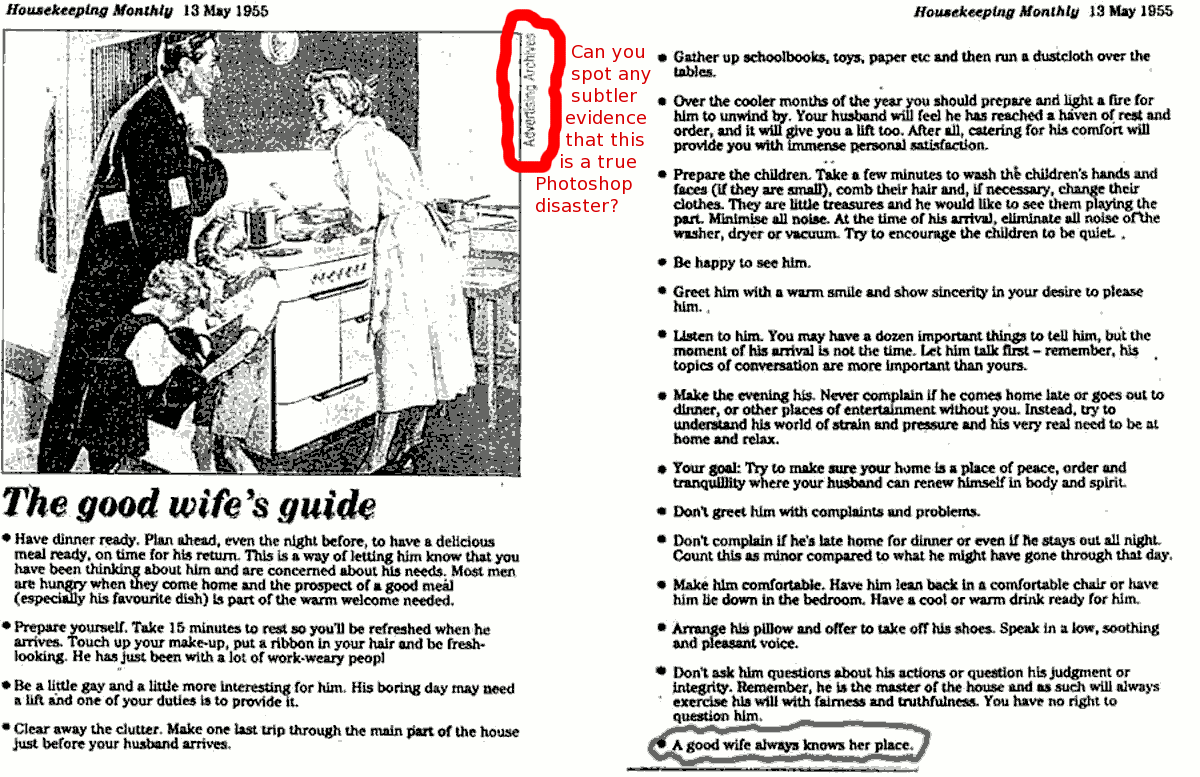
All of what I have said above has real imperfections and leaves enormous gaps. But I would like to address one question: Have I said I was going to offer guidance for rough situations and pulled a bait and switch, offering spirituality instead? To answer that, I recall one friend in high school who said with some disgust that he wished C.S. Lewis had left his religion out of The Chronicles of Narnia. I kept my mouth shut, but the suggestion struck me as strange, even clueless, like saying you wished Newton had kept all math out of his physics. To dislike Newtonian physics may be one thing, but it betrays some confusion to say that you like Newtonian physics but treat the math as an intrusion, as if the math had been artificially inserted like zombies and ultra-violence into Pride and Prejudice. C.S. Lewis was a man fascinated by myths and legends even before he became a Christian. Tolkein and others showed him his inconsistency in praising a pagan myth of a dying and rising god and then turning his nose up at Christianity as utterly trite; C.S. Lewis became a Christian precisely because he came to believe that the myths he loved all came together in Christ. Lewis crafted The Chronicles of Narnia out of love for all of these stories, and it is, to put it politely, a somewhat surprising suggestion to say that the story Lewis found truest and most beautiful simply does not belong in The Lion, the Witch, and the Wardrobe. And perhaps it is a bit of a surprising suggestion to say "Tell me what you can about surviving in a disaster, but recognize that your religion is irrevelant to this question."
Robert Heinlein, in Stranger in a Strange Land, wrote, when the characters faced a rather daunting emergency,
"...But I took other steps the first night you were here. You know your Bible?"
"Uh, not very well."
"It merits study, it contains practical advice for most emergencies..."
And this in a distinctly anti-Christian book. Perhaps the text goes on to a rather secular application of John, but the Bible is, among other things, God's own manual for how to deal with rough situations. (And this is to say nothing of the Orthodox Church.)
Saints Cheering Us On
The famous Hall of Fame (Hebrews 11:4-40 RSV) tells,
By faith Abel offered to God a more acceptable sacrifice than Cain, through which he received approval as righteous, God bearing witness by accepting his gifts; he died, but through his faith he is still speaking. By faith Enoch was taken up so that he should not see death; and he was not found, because God had taken him. Now before he was taken he was attested as having pleased God. And without faith it is impossible to please him. For whoever would draw near to God must believe that he exists and that he rewards those who seek him. By faith Noah, being warned by God concerning events as yet unseen, took heed and constructed an ark for the saving of his household; by this he condemned the world and became an heir of the righteousness which comes by faith. By faith Abraham obeyed when he was called to go out to a place which he was to receive as an inheritance; and he went out, not knowing where he was to go. By faith he sojourned in the land of promise, as in a foreign land, living in tents with Isaac and Jacob, heirs with him of the same promise. For he looked forward to the city which has foundations, whose builder and maker is God. By faith Sarah herself received power to conceive, even when she was past the age, since she considered him faithful who had promised. Therefore from one man, and him as good as dead, were born descendants as many as the stars of heaven and as the innumerable grains of sand by the seashore.
These all died in faith, not having received what was promised, but having seen it and greeted it from afar, and having acknowledged that they were strangers and exiles on the earth. For people who speak thus make it clear that they are seeking a homeland. If they had been thinking of that land from which they had gone out, they would have had opportunity to return. But as it is, they desire a better country, that is, a heavenly one. Therefore God is not ashamed to be called their God, for he has prepared for them a city.
By faith Abraham, when he was tested, offered up Isaac, and he who had received the promises was ready to offer up his only son, of whom it was said, "Through Isaac shall your descendants be named." He considered that God was able to raise men even from the dead; hence, figuratively speaking, he did receive him back. By faith Isaac invoked future blessings on Jacob and Esau. By faith Jacob, when dying, blessed each of the sons of Joseph, bowing in worship over the head of his staff. By faith Joseph, at the end of his life, made mention of the exodus of the Israelites and gave directions concerning his burial.
By faith Moses, when he was born, was hid for three months by his parents, because they saw that the child was beautiful; and they were not afraid of the king's edict. By faith Moses, when he was grown up, refused to be called the son of Pharaoh's daughter, choosing rather to share ill-treatment with the people of God than to enjoy the fleeting pleasures of sin. He considered abuse suffered for the Christ greater wealth than the treasures of Egypt, for he looked to the reward. By faith he left Egypt, not being afraid of the anger of the king; for he endured as seeing him who is invisible. By faith he kept the Passover and sprinkled the blood, so that the Destroyer of the first-born might not touch them. By faith the people crossed the Red Sea as if on dry land; but the Egyptians, when they attempted to do the same, were drowned.
By faith the walls of Jericho fell down after they had been encircled for seven days. By faith Rahab the harlot did not perish with those who were disobedient, because she had given friendly welcome to the spies. And what more shall I say? For time would fail me to tell of Gideon, Barak, Samson, Jephthah, of David and Samuel and the prophets -- who through faith conquered kingdoms, enforced justice, received promises, stopped the mouths of lions, quenched raging fire, escaped the edge of the sword, won strength out of weakness, became mighty in war, put foreign armies to flight. Women received their dead by resurrection. Some were tortured, refusing to accept release, that they might rise again to a better life. Others suffered mocking and scourging, and even chains and imprisonment. They were stoned, they were sawn in two, they were killed with the sword; they went about in skins of sheep and goats, destitute, afflicted, ill-treated -- of whom the world was not worthy -- wandering over deserts and mountains, and in dens and caves of the earth. And all these, though well attested by their faith, did not receive what was promised, since God had foreseen something better for us, that apart from us they should not be made perfect.
The image is of a stadium where athletes have run the full race, have received their crowns of victory, and now stand around cheering those who are still running: the faithful who are still in life's struggles.
This is not just the prophets and righteous saints from the Old Testament cheering on the first Christians; it is also the saints from the ages cheering on Christians today. If in America we have a revolution, and it turns out horribly, we will enter it with the prayers of the host of Russian saints. In the worst case, it will be an extremely difficult struggle, but there are others who have struggled before us and will stand, crowned in victory, cheering us on to join them in victory.
The text continues to call these saints, "a great cloud of witnesses." We do not know, for sure, what will happen, but whether we have a recovery or a maelstrom, the whole world, including the United States, will have the prayers of this great cloud of witnesses, including the vast army of Russian saints from ancient and modern times.
We have prayers, from Russia with love.